
Unlocking Ecosystem Opportunities in the Corporate Banking Segment for Cantonal and Regional Banks

Executive summary
Ecosystems — networked organizational designs involving multiple actors — offer cantonal and regional banks in corporate banking the opportunity to strengthen customer proximity, increase efficiency, and unlock new revenue pools. Success depends on a clear target vision, choosing the right role within the ecosystem, and robust decision bases for positioning, implementation, and ongoing development.
Five aspects are critical for building an ecosystem successfully: target vision, role, positioning, operating model, and continuous steering and further development.
Why ecosystems are strategically attractive for corporate and SME banking
Corporate clients — especially SMEs — are a strategically highly relevant segment for cantonal and regional banks. This relevance is particularly evident for cantonal banks: they extend around CHF 195 billion in loans to Swiss SMEs, representing a market share of over 50 percent. Moreover, for roughly one third of SMEs in Switzerland, a cantonal bank is their most important banking partner.[1] [2]
Today, networked business models are becoming increasingly important in corporate banking. Pressure on banks is rising: instant payments have been live in Switzerland since August 2024, and by no later than end-2026 all financial institutions active in customer payments must be reachable. For SMEs, this is not only about faster payments, but about end-to-end automation.
Because end-to-end processes from an SME perspective increasingly involve not only the bank itself — consider, for example, connectivity to SME ERP systems — the importance of connected offerings is growing. In parallel, Open Finance is gaining further relevance. One concrete example is Abacus connecting to SIX’s open banking platform bLink: account and transaction data as well as payment functionalities are thereby embedded directly into business software.[3] [4] [5] [6] [7]
For cantonal and regional banks, the topic of “ecosystems” (definition in the box below) is attractive because it can simultaneously help to strengthen their position at the customer interface, increase efficiency, identify paths to greater revenues beyond interest income, and drive growth.
Looking at international examples, Kaspi Bank illustrates particularly impressively how integrating many different services enabled it to build an end-customer-oriented ecosystem and thereby achieve a turnaround.[8] Today, end customers can access far more than traditional banking services via the banking app — for instance booking travel and shopping for clothing, all within a single application.
Because ecosystems create the opportunity to deliver even complex offerings at the customer interface, there is particularly strong potential in the SME segment, which is characterized by heterogeneity and high, individual integration requirements for offerings — combined with the pressure to keep solutions as simple as possible.
Those who integrate intelligently into SME processes strengthen their position at the customer interface, improve efficiency, and unlock revenue potential beyond the classic interest business. However, a realistic target vision is critical. Ecosystems are not merely a product idea; they are a steering model with clear roles, partners, data flows, and priorities. This is exactly where Horn & Company comes in: we create transparency, enable informed decisions, and help banks define and implement their place in the ecosystem effectively.
Definition of ecosystems as a networked organizational designs in corporate banking
Ecosystems represent a networked organizational design in which various organizations jointly contribute to delivering the offering to corporate clients. [9] The individual organizations take on different roles, from orchestrators to providers. Added value for corporate clients arises through a more comprehensive service offering. Value for the organizations involved in value creation is generated at different levels — however, the main objectives are often:
- Broader market coverage by offering a better value proposition
- Entry into new market areas by enabling new, more complex offerings
How building ecosystems can succeed
From our experience, regional and cantonal banks need to meet five prerequisites in order to leverage the potential of ecosystems strategically and effectively in corporate and SME banking.
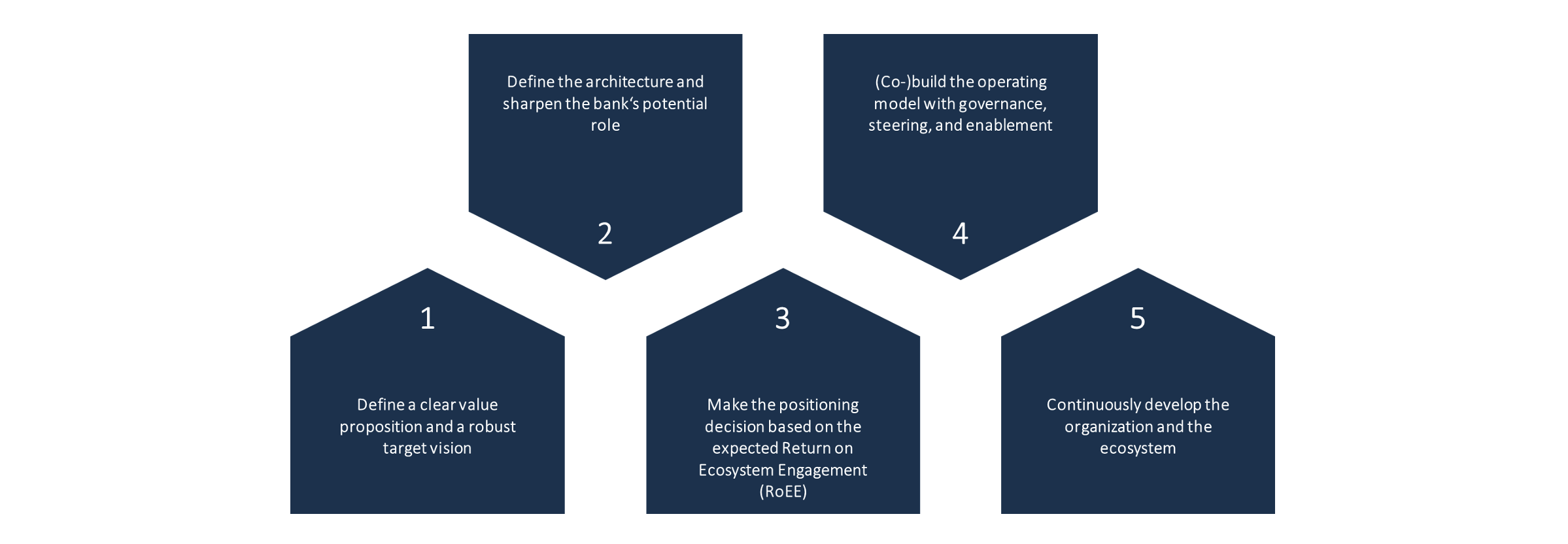
1. Define a clear value proposition and a robust target vision
The starting point is not the question of potential partners, but of concrete customer value. A useful basis is the corporate client customer journey. Depending on ambition, this journey can extend from “Banking” to “Near Banking” and “Beyond Banking.” The following examples from the financial services sector illustrate these different forms:
|
2. Define the architecture and sharpen the bank’s potential role
| Once the target vision is defined, the structure must be specified. In doing so, positioning options need to be tested realistically. A decision only makes sense on the basis of a clear assessment of the bank’s capabilities and the requirements for delivering value within the ecosystem.[9] |
3. Make the positioning decision based on the expected Return on Ecosystem Engagement (RoEE)
| RoEE is derived from various financial and non-financial aspects.[9] An evaluation should also consider different time horizons, as an ecosystem evolves in line with changing customer needs. |
4. (Co-)build the operating model with governance, steering, and enablement
An ecosystem is not a simple “add-on module” to an existing business model. Because new logics in collaboration and in value generation and capture come into play, it requires a dedicated perspective on the operating model.[13]
5. Continuously develop the organization and the ecosystem
| Especially in corporate banking, sustainable value rarely arises from the first iteration. It is created through continuous refinement based on actual usage and customer problems. Accordingly, an ecosystem should be viewed as a dynamic construct and developed further over time.[9] |
We support banks in building and scaling ecosystems in corporate banking.
| At Horn & Company, we support cantonal and regional banks end-to-end in building and scaling ecosystems in corporate and SME banking. We create robust decision bases for strategy, positioning, and implementation — from identifying relevant ecosystem fields and defining the right role to assessing the Return on Ecosystem Engagement (RoEE). |
Ready to take the next step?
Whether you have initial ideas or concrete plans – we listen, ask the right questions, and develop them further together. In a non-binding initial conversation, we explore where you currently stand and how we can support you.