AI in Asset Management – From RFP Automation to Operating Leverage

Swiss Asset Management Enters the AI Era from a Position of Strength — But Not from a Position of Comfort
Switzerland remains one of Europe’s leading asset-management hubs, with assets under management of roughly CHF 3.4 trillion at the end of 2024[1] and a strong reputation for stability, trust, and international reach. Yet the industry’s economics are becoming more demanding: growth is heavily market-driven, net new inflows are limited, margins remain under pressure, and consolidation is accelerating. Stability alone will not be enough to secure future competitiveness.
This is the context in which AI is arriving. Globally, AI capabilities are advancing quickly, while many companies are still learning how to turn experimentation into measurable value. For asset managers, the relevance is clear: AI directly addresses the economics of knowledge work, including research, reporting, compliance interpretation, portfolio commentary, data analysis, sales preparation, and client servicing.
AI should therefore not be viewed as another technology trend. AI is becoming a strategic lever at a moment when asset managers need new sources of productivity, scalability, and differentiation. The key question is not whether AI can produce a summary or a first draft. The question is whether firms can embed AI into core workflows in a way that improves speed, quality, and operating leverage.
For Swiss asset managers, this must happen within a high-trust model. Clients, regulators, and internal stakeholders will expect transparency, documentation, and control. AI adoption cannot simply mean faster experimentation; it must mean governed, auditable, and explainable implementation.
Before looking at AI through the lens of specific tools or technologies, asset managers should ask where the economics of their operating model are most exposed. In many firms, the answer lies in recurring knowledge workflows: processes that depend on expert input, approved content, document retrieval, version control, and repeated human review. These workflows may not always appear strategic at first glance, but they shape commercial speed, consistency, client responsiveness, and operating leverage. RFPs are a particularly useful starting point because they bring these dynamics together in one visible process: they are repetitive, knowledge-heavy, commercially relevant, and subject to high standards of accuracy and control. That makes RFPs an ideal first domain for understanding how AI can move from experimentation to practical transformation.
Stop Rewriting the Same RFP Answers: Where AI Can Create Immediate Leverage for Asset Managers
When it comes to RFPs, most asset managers do not have a knowledge problem. They have a retrieval problem.
The answers to institutional RFPs usually already exist somewhere: in old proposals, DDQs (Due Diligence Questionnaires), pitch decks, factsheets, ESG policies, risk documents, or SharePoint folders. But every new RFP still triggers the same manual process: search, copy, adapt, validate, and chase internal experts.
For small and medium-sized Swiss asset managers, this is more than an efficiency issue. It affects commercial capacity. The more time senior people spend reconstructing standard answers, the less time they have to tailor the proposal and win the mandate.
Here, AI can help — if applied pragmatically.
The opportunity is not to let AI submit final RFPs. The opportunity is to let AI create a strong first draft based on approved internal knowledge. Humans remain responsible for review, validation, and approval.
Done well, this can reduce days of manual work to hours while increasing the quality of the proposal at the same time.
Why RFPs Are an Ideal First AI Use Case
RFPs are repetitive, knowledge-heavy, and commercially relevant. Many questions appear again and again with only slight variations:
- “How do you manage risk?”
- “How is ESG integrated?”
- “What differentiates your strategy?”
- “How is the team structured?”
- “What reporting do you provide?”
The challenge is rarely writing from scratch. The challenge is finding the latest approved answer and adapting it to the client context.
This is exactly where AI can perform well when set up in the right way: retrieving relevant internal material, summarizing it, drafting a response, and highlighting gaps that require human input.
What a Practical Set-up Looks Like
A realistic starting point does not require a large AI transformation programme.
An asset manager can begin with one controlled RFP knowledge area containing:
- approved past RFP answers
- DDQs and pitch decks
- factsheets and strategy descriptions
- ESG, risk, operations, and fee language
- team bios, reporting examples, and legal disclaimers
When a new RFP arrives, an AI assistant can use this approved material to create a first draft, show sources, and flag missing information.
The relationship manager then adapts the answer. Portfolio management validates technical content. Compliance reviews the final version.
This comes down to one simple principle:
AI drafts. Humans decide.
Three Realistic Paths
Before outlining the three approaches, it is important to understand that a successful implementation is based on the following fundamentals: clear AI rules, secure handling of sensitive data, structured information, approved answers, version control and human review.
Each path can be understood along two dimensions: how the underlying knowledge is organised, and how that knowledge is turned into a working RFP solution. The two tend to scale together.
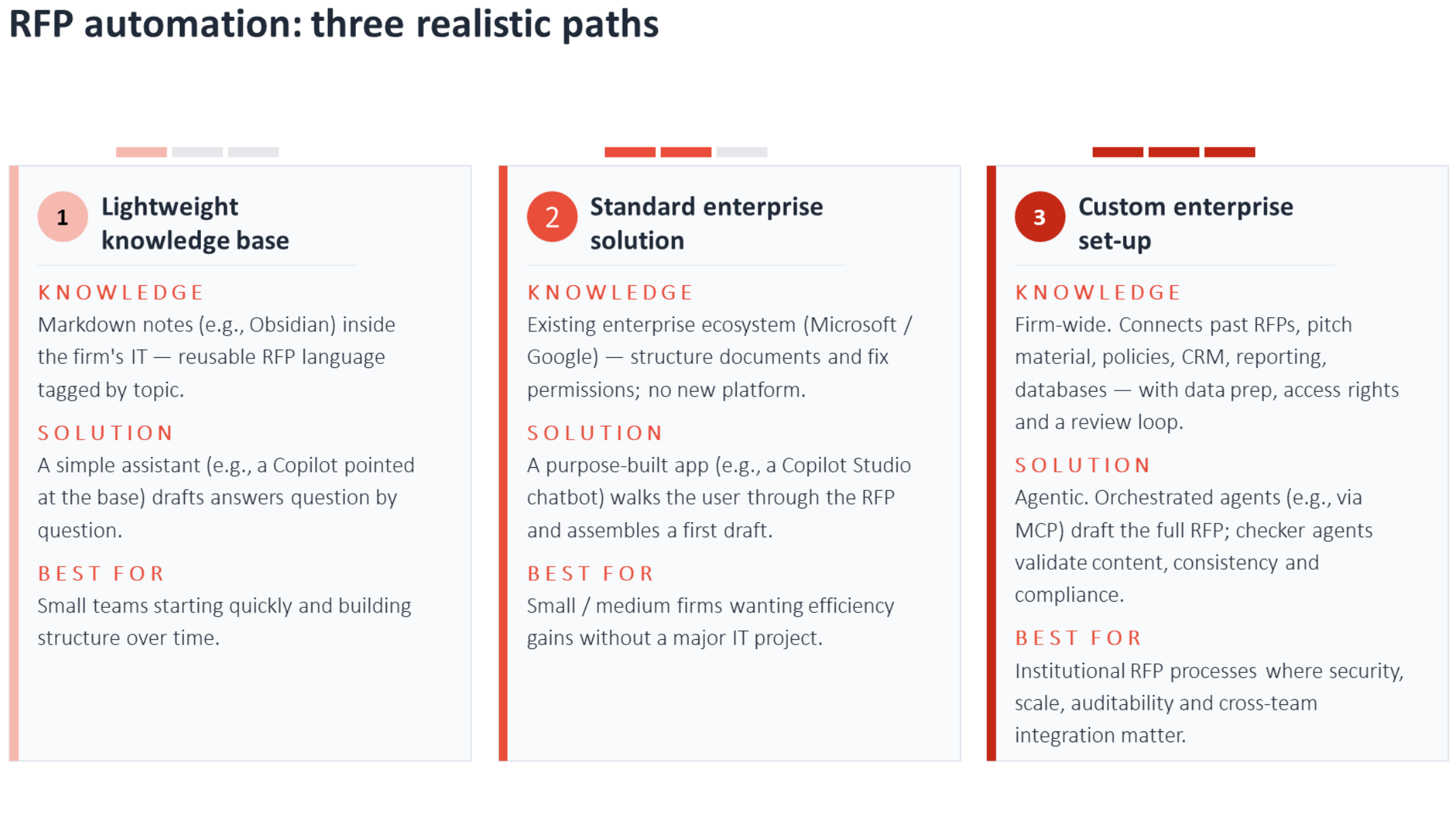
1. The Lightweight Knowledge Base
Knowledge: For small teams, a practical first step can be a structured internal knowledge base built in Markdown files, for example in Obsidian, and stored within the firm’s existing IT environment.
In practice, teams can use this set-up to collect and maintain reusable content such as product explanations, methodology descriptions, standard answers, process notes, and past RFP language. Information can be organised into clearly structured notes, tagged by topic, client type, or use case, and updated continuously as new material becomes available.
Solution: On top of this, a lightweight assistant, for instance a Copilot pointed at the knowledge base, lets the team query the material question by question and draft individual answers. The workflow stays manual and prompt-driven, but every draft is grounded in approved internal content rather than generated from scratch.
Best for: Teams that want to start quickly with a low-complexity set-up and gradually build a more structured knowledge base over time.
2. The Standard Enterprise Solution
Knowledge: For many Swiss asset managers, this is the most practical near-term path, since they are already working in enterprise ecosystems, such as Microsoft or Google. Instead of building a new platform, they can structure existing documents, clean up permissions, and use AI capabilities within the existing environment to produce new drafts based on existing data.
Solution: Here the assistant becomes more guided. A purpose-built application, for example a chatbot in Copilot Studio, can walk the user through the questions of an RFP, retrieve the relevant approved content for each, and assemble a structured first draft within the existing environment. The relationship manager adapts the answers, portfolio management validates technical content, and compliance reviews the final version.
Best for: Small and medium asset managers that want efficiency gains without a major IT project.
3. The Custom Enterprise Set-up
Knowledge: Unlike the Lightweight knowledge base, which is mainly useful for one person or a small team, a more advanced enterprise set-up is designed to support the whole organisation.
It connects different approved internal sources, such as document folders, past RFPs, pitch material, policies, CRM notes, reporting data, and internal databases. The goal is to make firm knowledge easier to find, reuse, and control at scale.
To work properly, this kind of set-up needs four things:
- Reliable data preparation
The firm needs a process to collect, structure, update, and keep internal documents in sync across different systems. - A scalable knowledge store
The information needs to be stored in a way that allows the AI assistant to quickly find the most relevant content, even across a large number of documents. - Clear access rights
The AI assistant should only use documents that the specific employee is allowed to see. This is critical for confidential client data, investment information, and internal governance. - Review and improvement process
Users need an interface where they can see which sources were used, check the answer, correct mistakes, and feed improvements back into the system.
Solution: At this level the solution becomes agentic. An orchestrated workflow, for example using MCP to chain specialised agents, can draft a complete RFP end to end, with dedicated checker agents validating content, consistency, and compliance along the way. Human review is concentrated where it matters most: a final check of the full document before submission, rather than a manual pass on every individual answer.
Best for: Institutional RFP processes where security, scale, auditability, and integration across different teams and systems are essential.
In simple terms: a lightweight knowledge base helps a small team organise and reuse knowledge with a simple assistant on top; a standard enterprise solution guides users through the RFP within their existing tools; and a custom enterprise setup orchestrates agents to draft the full document, with humans focusing on the final review.
The Real Differentiator Is Not the AI Model
Most asset managers are asking the wrong question.
The question is not: “Which AI model should we use?”
The real question is: “Is our knowledge structured well enough for AI to use it safely and efficiently?”
In most RFP processes, the problem is not writing. It is fragmented information: outdated answers, inconsistent ESG wording, scattered documents, and unclear ownership.
If that foundation is messy, AI will not fix the process. It will simply make the mess faster.
That is why successful AI adoption starts with process design and a focused MVP (Minimum Viable Product), not a large transformation programme.
A practical first step is simple:
- choose one strategy or product
- collect a few historical RFPs and approved supporting documents
- structure the material in one controlled knowledge area
- define review and approval responsibilities
- test whether AI can generate a usable first draft
Then measure what matters: time saved, answer quality, review effort, and compliance comfort.
The real value is not just faster RFPs. The pilot shows leadership teams how ready the organisation is for broader AI adoption: structured knowledge, clearer ownership, governed workflows, and secure handling of sensitive information.
The firms that benefit most from AI will not necessarily be those with the best models — but those with the best-organized knowledge and processes.Where AI Needs Guardrails, Not Just AccessThe case for AI in RFP work is strong, but it is not unconditional. The same characteristics that make RFPs an ideal use case (high standards of accuracy, regulatory sensitivity, and commercial consequence) are also what make a careless implementation risky. Three risks deserve explicit attention:
First, accuracy and hallucination. An AI assistant can produce a fluent answer that is subtly wrong, e.g. an outdated fee figure, an ESG claim the firm can no longer substantiate, a risk statement that no longer matches the strategy. In an RFP, an inaccurate answer is not a drafting error; it is a representation made to a prospective client. This is precisely why the model drafts and humans decide. The review step is not bureaucratic friction; it is the control that makes the speed gain safe.
Second, accountability. A first draft generated from internal knowledge does not transfer responsibility to the tool. The firm remains accountable for every statement it submits. Clear ownership of answers, documented approval, and traceable sources are therefore not optional features of an AI workflow. They are what allows the firm to stand behind the output.
Third, data residency and confidentiality. RFP material touches client data, investment information, and internal governance. For Swiss asset managers in particular, where the content sits, who can access it, and whether sensitive data leaves the firm's controlled environment are first-order questions and not implementation details to be resolved later. The right architecture depends as much on these constraints as on the AI capability itself.
None of this is an argument against AI. It is an argument for governed AI. The firms that move fastest in the long run will be those that build these guardrails in from the start, rather than retrofitting them after the first uncomfortable answer reaches a client.
Where to Start: From AI Use Case to Operating Leverage
For asset managers, AI does not need to start with portfolio construction, alpha generation, or fully automated investment decisions.
The more immediate opportunity lies in operational leverage: workflows that already consume too much expert time, rely on fragmented internal knowledge, and require repeated drafting, review, and validation. RFPs, DDQs, pitch material, client reporting, sales preparation, and knowledge management are prime examples.
The goal is not full automation. The goal is a better first draft, faster access to approved internal knowledge, greater “on brand” consistency across client-facing material, and more time for teams to focus on judgement, differentiation, and mandate-winning work.
But this will not happen by simply giving teams access to an AI tool. Asset managers need to do the operating-model work: map the processes where AI can create value, identify the bottlenecks, define ownership for knowledge and content, clarify access rights, and establish human review where quality, compliance, or client trust are at stake. In practice, AI is only as useful as the workflow, data, governance, and adoption model around it.
That is why the best starting point is a focused pilot — narrow enough to be manageable, but relevant enough to prove value. RFP automation is such a starting point because it is concrete, measurable, and close to revenue.
But the broader implication is larger: firms that learn how to structure knowledge, govern AI use, and embed human review will be better positioned to apply AI across client service, reporting, compliance, sales, and investment communication.
Therefore, for many small and medium Swiss asset managers, the right starting question is simple:
Get to know the companies behind the whitepaper
Sources
[1] Asset Management Association: Swiss Asset Management Study 2025. The Swiss asset management industry: a reliable anchor in stormy times.