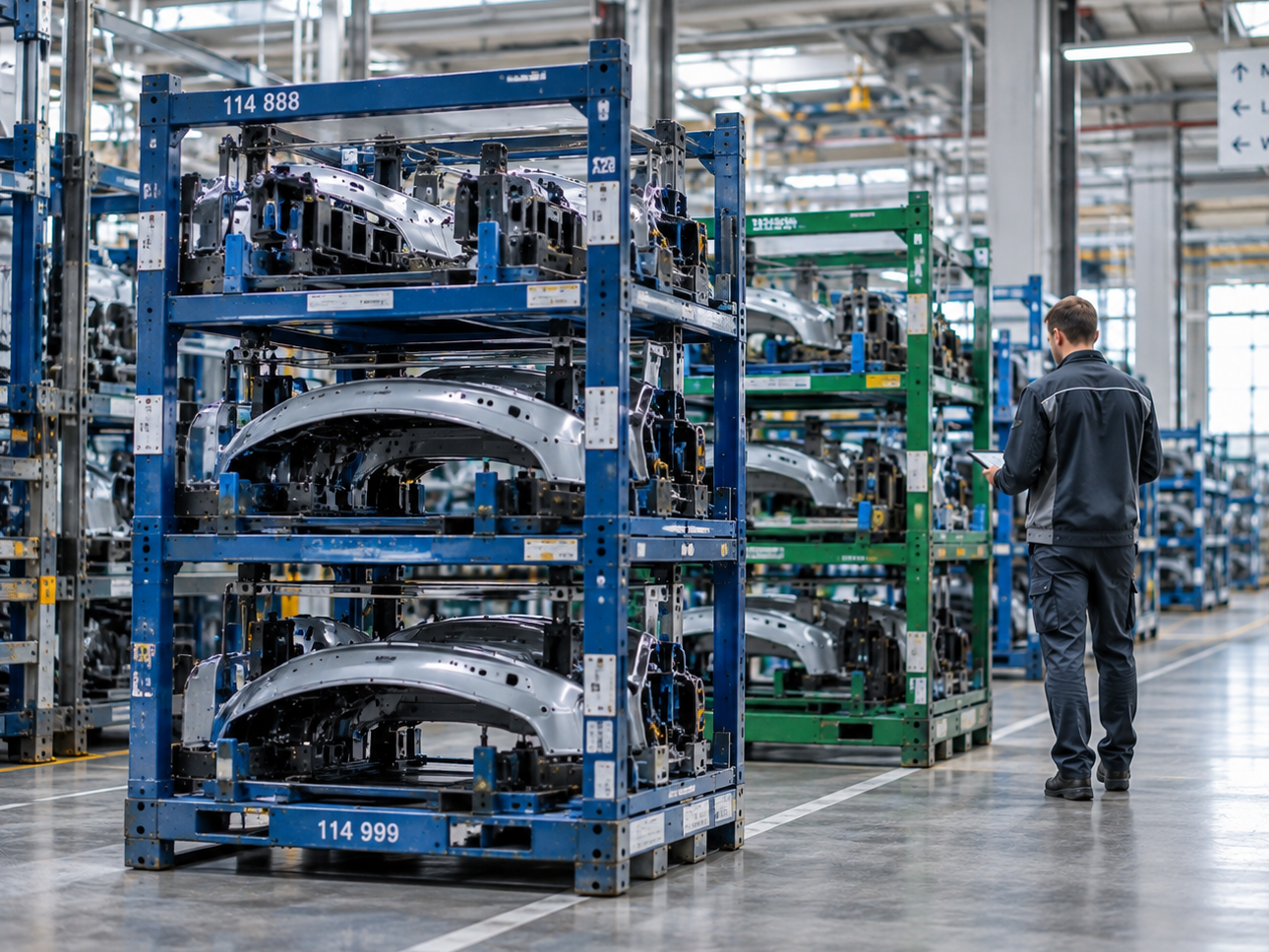
Production Ramp-Up in the Defense Industry: Working Together to Ensure Supply Capability

Five Reasons Why Production Ramp-Up in the Defense Industry Is Stalling
The causes often lie not in a lack of investment, but in the structural limitations of the existing industrial system. Five challenges are particularly relevant:
- Products were designed for performance, not for scalability. A wide variety of variants, custom interfaces, tight tolerances, assembly steps that are difficult to automate, or complex final inspections are manageable at low production volumes. However, during ramp-up, these quickly become bottlenecks. In addition to “design-to-cost,” the industry therefore increasingly needs a consistent design-to-scale approach: standardized components, scalable product architectures, and repeatable production processes
- Production systems often follow a project-based rather than a mass-production logic. While additional shifts, floor space, and equipment increase nominal capacity, they do not eliminate unstable processes, a lack of standards, or inefficient material flows. In the worst-case scenario, it is not output that is scaled, but rather the existing inefficiency. Industrialization must therefore precede capacity expansion.
- The critical bottleneck increasingly lies outside the company’s own plant. While OEMs and Tier 1 suppliers often have a good understanding of their own capacities, dependencies in lower tiers of the supply chain sometimes remain invisible. Bottlenecks in electronics, optics, specialty materials, or specialized manufacturing processes can limit the throughput of the entire system. A confirmed Tier 1 capacity, therefore, does not constitute a reliable supply commitment.
- Industrialization and qualification limit ramp-up more than sheer machine capacity. Tooling, product and process approvals, engineering changes, personnel qualifications, or the approval of alternative supply sources often determine the actual time-to-rate. The key is the synchronized ramp-up of all relevant maturity levels.
- Rising volumes require a different operating model. Traditional customer-supplier relationships are often organized too sequentially: report demand, confirm capacity, identify discrepancies, and escalate. In dynamic ramp-ups, this transparency comes too late. Instead, development, procurement, production, quality, supply chain, and finance must work together to manage the process across organizational boundaries.
The result: simply doing more of what’s already being done does not automatically mean more output. The key is to align the entire industrial system with a new scale of operations.
What limits the actual production rate?
For management, therefore, the primary focus is not so much on what capacities are available. Rather, the key question is what production rate the entire network can reliably deliver at any given time, and what constraints are currently preventing that rate.
A traditional capacity assessment is not sufficient for this. What is required is a robust end-to-end capacity model that breaks down the target output of the entire system into products, components, manufacturing stages, and suppliers. In addition to technical capacities, the model must also reflect whether the necessary conditions for ramp-up are actually met. This includes, for example, whether sufficiently qualified personnel are available and whether suppliers can finance the necessary investments.
The economic dimension, in particular, is often underestimated in a growth environment. A supplier may havea strong order backlog and still be unable to fund its production ramp-up upfron. Additional inventory, tools, equipment, and personnel tie up liquidity long before they generate revenue.
Consequently, traditional supplier management is increasingly giving way to supplier enablement. OEMs must not only monitor critical partners but also work with them to create the conditions necessary for ramp-up. This includes support for industrialization, technical product adaptations, coordinated investments, as well as stabilizing subcontractors or establishing additional sources of supply.
Our Approach: Six Dimensions for a Successful Production Ramp-Up
Our experience with supplier improvement and supplier turnaround demonstrates how important it is to combine short-term supply security with sustainable resolution of root causes. Operational stabilization, industrial performance, and financial robustness must be considered together.
This is precisely where we begin with an integrated end-to-end diagnosis. The goal is not just another readiness score; rather, it is to gain a solid understanding of the few remaining constraints that are actually limiting the ramp-up.
To this end, we consider six interrelated dimensions:
- Product & Design-to-Scale: Can the product be industrialized for the planned production volumes?
- Production System: Can the processes, layout, automation, and organization consistently achieve the target production rate?
- Supplier Network: Which dependencies across Tier 1, Tier 2, and other supply levels limit output?
- Industrialization & Qualification: Where are maturity levels, approvals, engineering changes, or second-source qualifications causing delays?
- Capacity & Financial Readiness: Are investments, personnel, materials, and liquidity secured for the ramp-up?
- Ramp-up Operating Model: Is there a shared set of facts, clear decision-making authority, and effective management across organizational boundaries?
The diagnosis results in a prioritized transformation plan. Depending on the bottleneck, three basic courses of action are available: Scale — making existing capacities more efficient; Duplicate — establishing additional capacities, tools, or sources of supply; or Substitute — modifying products, components, and manufacturing processes to enable alternative solutions.
Which option makes sense depends on criticality, training requirements, investment needs, time, and the risk of downtime. The goal is not maximizing redundancy, but rather an economically viable and resilient production network.
H&C’s project experience demonstrates that consistent industrialization can have a significant impact even in complex production environments: During the development of an assembly concept for a multi-role fighter jet, lead time was reduced by 40 percent and productivity increased by 30 percent. In a European supplier network serving the automotive and specialty vehicle sectors, on-time delivery performance improved by 20 percentage points to 97 percent, and lead time was cut in half.
These project-specific results are not general defense industry benchmarks. However, they illustrate the potential inherent in the integrated optimization of product, production, and supply network.
From Bottleneck to Collaborative Ramp-Up Management
Identifying bottlenecks is just the beginning. The key is to resolve them quickly and sustainably.
To do this, OEMs and critical suppliers need a shared ramp-up operating model. At its core are an integrated volume and schedule plan, coordinated maturity levels, a comprehensive bottleneck register, and agreed-upon actions and clear decision-making authority.
Management focuses on a few key performance indicators critical to success:
- Time-to-Rate,
- end-to-end capacity coverage,
- Supplier Readiness,
- On-Time Delivery (OTD/OTIF), and
- single-point-of-failure exposure.
A joint ramp-up office brings together decision-makers from R&D, procurement, production, quality, supply chain, and finance. It creates transparency, accelerates decision-making, and ensures that initiatives do not falter at organizational boundaries.
To achieve this, Horn & Company combines strategic network design and production footprint planning with operational industrialization. We also draw on our expertise in supplier enablement, performance improvement, and financial stabilization and restructuring. Consistent on-site implementation is crucial — from resolving acute bottlenecks to achieving a stable, sustainable production rate.
This also changes the roles:
- Role of the OEM: from client and capacity monitor to orchestrator of industrial performance.
- Role of the supplier: They, in turn, must be prepared to transparently disclose their actual constraints, including those of subcontractors, investment needs, and financial limitations.
Delivery capacity is created within the network
Growth in the defense sector will not be driven solely by the companies with the most contracts or the largest investment budgets. The decisive factor will be which companies can adapt their industrial systems to the next level of scale most quickly and reliably.
Simply expanding existing structures is not enough. Products must be more scalable, production systems must be better suited for mass production, critical suppliers must be capable of ramping up, and decisions must be made more quickly across organizational boundaries.
The crucial question, therefore, is no longer, “Has every supplier confirmed its capacity?” but rather, “What production rate can our entire industrial network reliably deliver, and what changes must we make together today to reach that next rate?”
Supply capability in the defense sector does not arise at the factory gate. It arises through the joint industrialization of the entire network.
Companies looking to achieve and sustain higher production rates must identify tomorrow's supply chain constraints today. A targeted end-to-end diagnosis lays the foundation for this and identifies which measures will have the greatest impact on supply capability and time-to-rate.
Talk to
our experts
Contact us. Together, we'll identify what's currently preventing you from reaching your next production rate.