
Those who don't know the production costs cannot justify the price

//AI-Generated Image
In many companies in the consumer goods and process industries, list prices and net prices are known down to the SKU level. However, the manufacturing costs on which these prices should be based are often unknown. Instead, a standard rate is entered into the system, and a package of terms and conditions is negotiated. Information on what a specific item actually costs at a plant — given a specific capacity utilization rate and the production parameters used — is either missing or arrives too late.
This is not a theoretical controlling issue, but a real profitability problem. Items and customers remain in the product mix even though they fall short of the required profit contribution. Private labels then displace the brand without the displacement effect being immediately visible in euros. Packages are considered successful because the total contribution margin is correct, even though individual items are eating into the package’s profit. The company loses profit and, in the end, doesn’t know exactly where.
Pricing therefore requires a cost of goods sold calculation that can do two things simultaneously: reflect the actual costs incurred and disclose the allocation keys used. A number without allocation keys cannot be managed. An allocation key without up-to-date data is not convincing, either internally or in retail.
Thesis: Pricing is based on production costs. If you do not know the exact production costs, you cannot justify your pricing terms.
In the current environment, imprecise statements are becoming more costly, not less common
Costs continue to shift; standard formulas and annual cycles no longer support the DB lower limit.
Following a period of slowing cost growth, production costs have risen noticeably again in 2025. Public surveys (including the New York Fed, March 2026) report cost increases of just over eight percent for the manufacturing sector, with materials and intermediate inputs showing similar trends. Energy, insurance, and non-wage labor costs are added to this. Raw materials are now just one driver among many.
Price pressure remains high for German manufacturers. Discounters, purchasing cooperatives, private labels, and price-sensitive consumers leave little room for maneuver. Those who cannot substantiate additional expenses cannot pass them on — they must bear them themselves. That is why transparent cost categories are needed instead of surcharge upon surcharge.
This is precisely where the management gap lies. Standard costs work as long as the forecast holds true. If it no longer does, safety margins increase, the cost calculation loses credibility with retailers, and internally, reported margins and price variances diverge. Contribution margin analysis then provides little reliable information about the product range and the customer. The costs necessary to set a reasonable price are not determined with sufficient precision.
An HK monitor responds to volatility: not by relying on a fixed annual formula, but by continuously comparing actual and target HK levels with the customer's terms and conditions.
What “exact production costs” actually means
No more decimal digits, but data, keys, and a framework that matches capacity utilization.
Actual costs are, in theory, the most accurate basis for pricing. In practice, however, relying solely on actual costs is often too late, too expensive, or incompatible with inventory valuation. The solution, therefore, is not to use “all actual” costs, but rather a deliberate framework: volatile components (raw materials, energy, packaging) as close as possible to actual costs; stable components (such as standard wages) based on standard rates. Every allocation key is documented, versioned, and assigned an owner.
Three things must all be in place at the same time:
- The data: In addition to accurate bills of materials, yield, scrap, energy, machinery, labor, and time tracking must be based on current data, not on the budget.
- The key factors: If you can’t explain why this cent is on this item, you can’t defend the price in the retail market.
- The cost structure: The decision between full-cost accounting and DB2 is not a matter of corporate dogma, but rather follows business considerations, such as plant capacity utilization.
Pricing an item requires three perspectives: planned, actual, and a break-even point. If you only have one number, you can't monitor it.
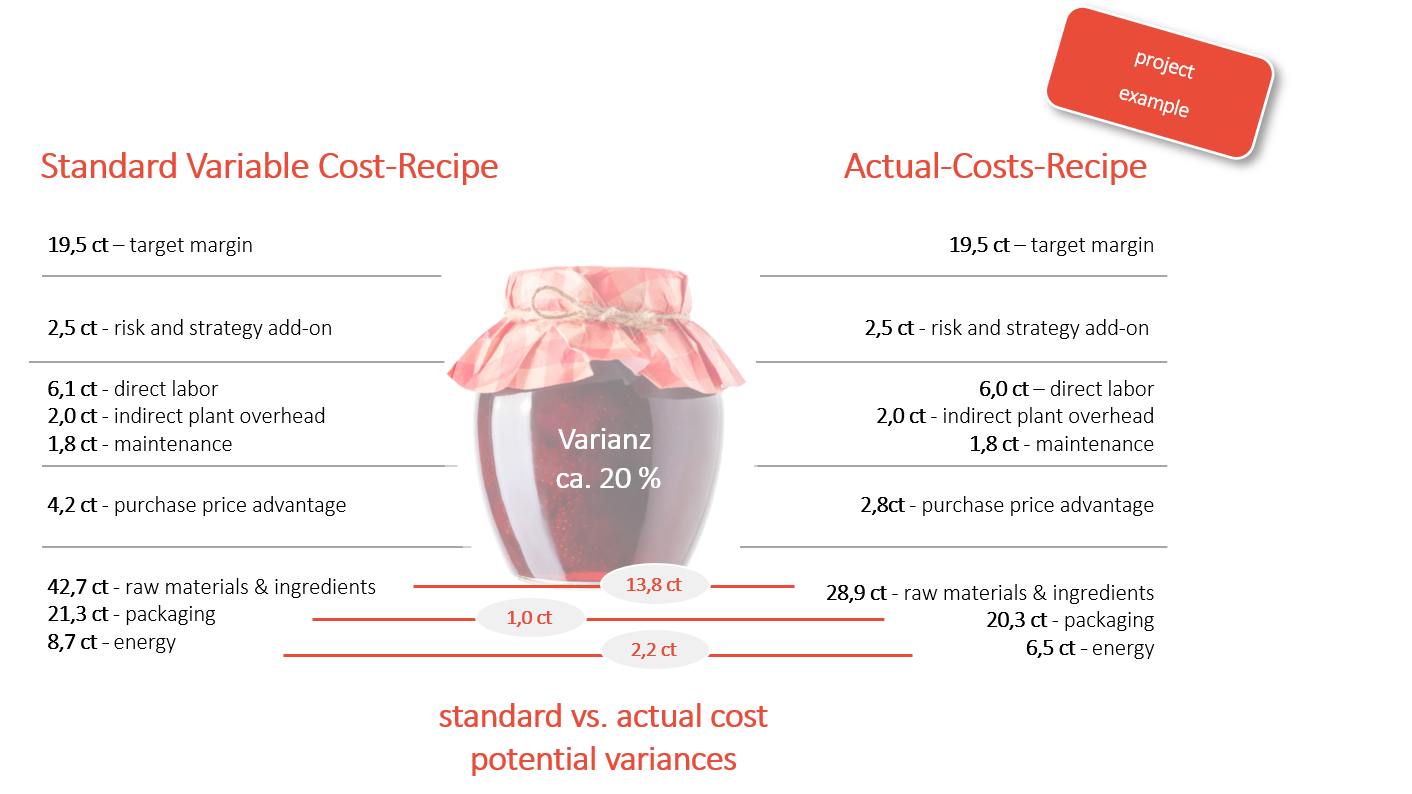
A real-world example from a project: standard cost formula versus actual production costs. The discrepancy isn't a rounding error — it skews the result if no one notices it.
Full-cost or DB2: Capacity utilization determines the framework
FMCG: Full costs at full capacity; with scalable capacity, DB2 is a better option.
When capacity is fully utilized, any additional volume crowds out other business. In this situation, the relevant cost basis is full-cost accounting. In this scenario, brand-name products typically represent a better business opportunity than private label: Limited capacity must be allocated to those items that generate the highest contribution based on full costs. A private label listing under full capacity does not result in increased volume but rather in a loss of profit — a fact that, unfortunately, is often not recognized until it’s too late.
If capacity can be scaled — for example, through spare production lines, seasonal lulls, or additional shifts — then the sensible focus is on costs up to DB2 (direct and indirect costs). In this case, producing and utilizing capacity is economically sound, even if the absolute profit remains slim. The lower limit shifts: utilize capacity, yes, but the rule remains: no negative DB2 on individual items.
A negative item DB2 is only acceptable if it is deliberately accepted out of strategic necessity — for example, because an item is part of a larger package that, taken as a whole, contributes enough to be attractive. It is precisely in such cases that true production costs become not merely optional, but essential. Otherwise, the package subsidizes hidden loss-makers, and no one can tell which item contributes to the bottom line and which one eats into it.
A group-wide average across both fully utilized and underutilized plants skews this analysis. The monitor must display the current utilization rate, not that of the last budget cycle.
Rule of thumb: Full capacity utilization = full costs and brand before PL. Scalable capacity = DB2; negative only in the core package.
Brand, Private Label, and the Terms and Conditions Package
Without a real HK, the money-loser remains in the package, and the listing is considered a success.
In annual negotiations with food retailers, what matters isn’t the sophistication of the calculation, but whether the base price is appropriate for the situation and can be substantiated. Full production: no deals below full cost; brand before private label. Available capacity: utilize it for DB2; don’t let individual items drag the average into negative territory. Bundles: only include add-ons if the carrier actually maintains the contribution.
Two Monitors, One True Cost
The HK Monitor tells you how much the item costs. The Pricing Monitor tells you whether the contract covers it.
The Cost of Goods Manufactured Monitor tracks three sets of figures — plan, actual, and profitability — for each item and plant. It breaks down variances by driver: materials, yield, energy, manufacturing, and any allocation keys. The timing depends on the production and seasonal calendar: as close as possible to the point of maximum cost transparency, ideally at or shortly before the start of the campaign’s production. Whether full-cost or DB2 applies depends on the current capacity utilization and is shown in the monitor, not in a footnote.
he Pricing Monitor compares the same criteria against the actual net proceeds: terms, pricing tiers, ancillary services, and clauses. It checks whether index and escalation clauses still align with the actual net proceeds and whether an item in the customer package is a “driver” or a “follower.” If any noticeable discrepancies arise, action must be taken. The permissible responses are: maintain, renegotiate, stop the promotion, delist, or replace. A deviation without action is a report, not a monitor.
Both views share the same keys and product master data. The disconnect between Controlling (which calculates) and Sales (which negotiates) is the most common reason why profit disappears without being attributable to a specific decision.
Cost Accounting sets the unit price. Sales sets the selling price. The monitor highlights the variance and provides the basis for taking action.
Key figures must be justifiable — otherwise, the price is indefensible
Transparency is essential for credibility during the annual review.
A safety margin included in the price is no substitute for transparent allocation. To the market, it appears to be an implausible adjustment. Internally, it obscures which block was actually driving the price. Risk and strategy therefore do not belong in the HK, but in a separate, visible block.
From the production schedule to the quote calculation — and don't stop there
Provide the HK as close as possible to the start of production; hold it against the net amount after the contract is signed.
Cost transparency is at its highest at the start of production. That’s why the cost of goods sold (COGS) calculation should take place as close as possible to this point — ideally as a fixed part of the seasonal or production calendar. However, the sales quotation process often begins earlier. If you calculate using the previous year’s or budgeted COGS at that stage, you’ll end up with inflated risk premiums or deals that are quietly signed off on despite being loss-making.
This is not a project for Controlling alone. Purchasing (prices, contracts, discounts), Production (when, where, what quantity), SCM (availability, fulfillment), and Sales (customer, terms, package) must all use the same parameters. When departments operate in isolation, their uncertainties accumulate and are ultimately factored into the price. This then makes quotes unreliable or unprofitable.
Once the contract is signed, the monitoring really begins. Actual cost of goods sold versus net revenue, clauses versus current drivers, the package versus enablers and followers. A 14-day cycle for outliers and a monthly reconciliation between costs and revenue are sufficient; another committee is generally unnecessary. One escalation path, one owner, one action list. Below: from isolated actuals to an end-to-end (E2E) process spanning Controlling, Purchasing, SCM, Production, and Sales.
Objective: For every relevant offer and every current term, it is clear which calculation basis applies and why.
What Must Come First
Not the entire portfolio. A robust framework, open-ended solutions, and initial steps.
First, define the cost structure: full costs at full capacity, DB2 for scalable capacity, negative item DB2 only in the main package. Document the rule in writing, including what must not be simplified intentionally.
Second, open the data and keys on a manageable cluster: typically a few dozen SKUs across brand and private label, at least one plant, the relevant retail customers, associated bill of materials, and their actual allocations. Without this subset, the monitor remains nothing more than an architectural diagram.
Third, conduct an initial run focused on action, not just traffic lights: identify specific renegotiation, clause, or delisting cases for the next meeting. Only once this run has prompted a decision-making body to make changes is it worth expanding to the entire product range.
The concept, process, and system can run in parallel. The core of the concept is the monitor, not a one-time recalculation.