
Reinvestment – an untapped value lever for life insurance in Switzerland

At a glance
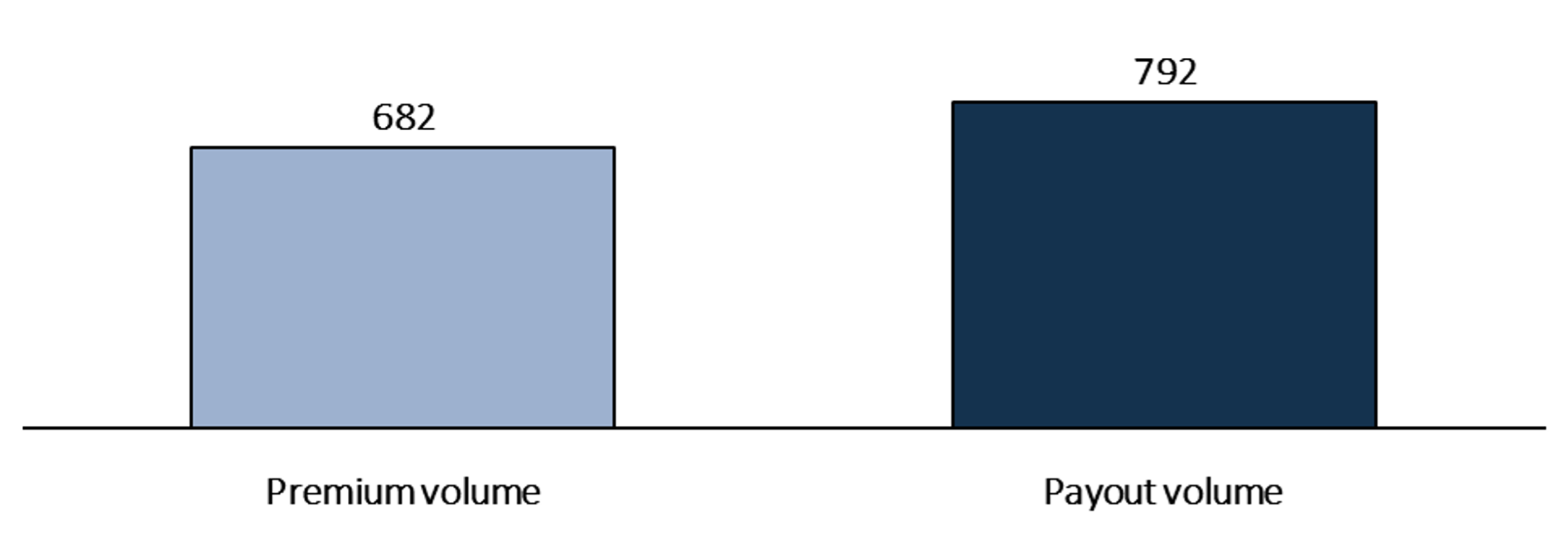
| In the life business, every policy maturity re-opens the question of whether funds remain on the balance sheet or flow out to banks, asset managers and digital platforms. For a typical Swiss life insurer, annual payout volume in individual life business is on a par with premium volume – indeed exceeds it. A substantial share of the market is therefore decided not in new business, but in the in-force book. |
| The reinvestment rate is thus no longer a mere in-force metric. It is the central measure of whether a life insurer remains relevant at the moment of retirement and payout decisions. Insurers that identify maturity events early, engage clients purposefully and offer suitable follow-on solutions generate growth from existing relationships – where the client relationship is already in place and the acquisition costs of new business do not arise. |
The in-force book is becoming a decisive playing field
Overall, the Swiss life insurance market is contracting. FINMA reports an 8.4% decline in life insurers' gross written premiums for 2024. Group life business in occupational pensions continued to account for 60.7% of volume. Look closer, however, and the picture is more. nuanced: unit-linked life insurance, for instance, grew by 5.9%. The return on investments stood at 2.41%, and 97% of investments remained in tied assets. [1] In this market environment, further growth through new business alone is becoming challenging, and securing premium volume through existing client relationships is gaining in importance. Current conditions further favour such a focus: 1. The demographic transition: with the baby-boomer retirement wave, the number of plannable payout and investment decisions will rise markedly over the next ten years. 2. Distribution triggers in the Swiss pension landscape: the rejection of the BVG reform on 22 September 2024 shifts the pressure to act onto private pension provision; from tax year 2026, retroactive pillar 3a purchases for contribution gaps arising from 2025 onwards will be possible for the first time; and in December 2026 the 13th AHV pension will be paid out for the first time, changing the retirement planning of many households. These distribution triggers affect not only new clients but above all the existing client base, whose retirement planning is being reassessed as a result. 3. Increasing market concentration: the merger of Helvetia and Baloise, completed on 5 December 2025, created Switzerland's largest multi-line insurer, with a market share of around 20%. [2] Swiss Life still leads the life business with around 41%, but the merged group, now a clear number two with roughly a quarter of the market, is closing in on the leader. [3] Driven by announced run-rate synergies of some CHF 350 million a year (pre-tax) and a yield-oriented management approach, the new competitor is raising efficiency pressure across the entire market. [4] The in-force business, in which funds are retained without acquisition costs, is one of the most efficient sources of growth. Insurers that do not manage it actively cede it to competitors with a lower cost base. |
The gap is not the outreach. It is the system behind it
| In the cases analysed, reinvestment rates range from below 5% to more than 20%. A spread of this magnitude is no accident. It reflects systematic differences in processes, data and sales management |

| Most Swiss life insurers contact clients before their policies mature. Nevertheless, a relevant share of funds flows out. The cause rarely lies in any single letter, but in an often fragmented value chain spanning in-force management, distribution, product and operations, in which the reinvestment rate is too rarely managed as a central steering metric. |
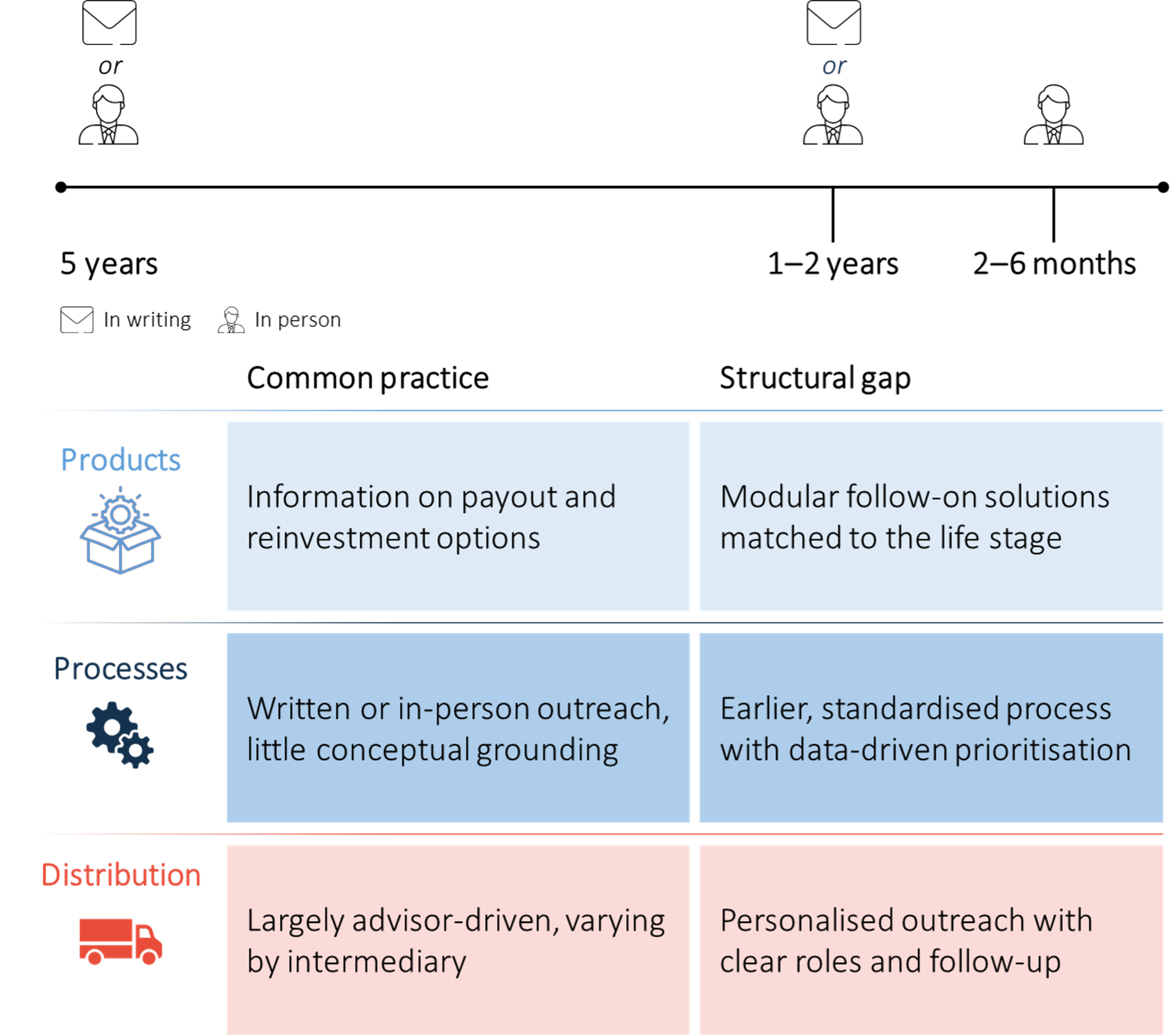
Banks, asset managers and digital pension platforms often operate in this discipline with real operational edge. They segment early, talk about wealth rather than maturity, reduce friction at the point of sale and make the next step as easy as possible for clients.
The three building blocks of an effective reinvestment model
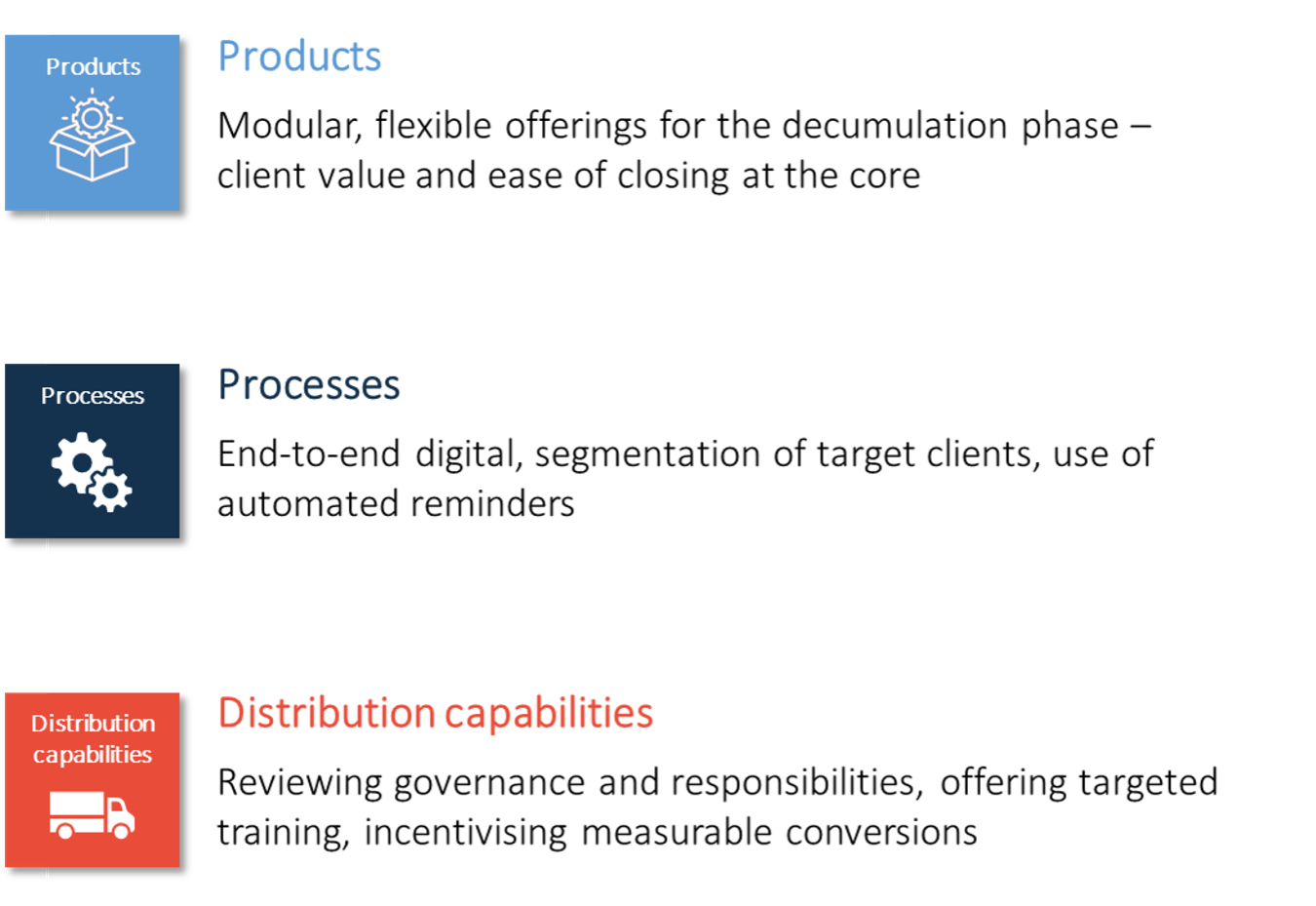
Building block 1: gearing product and service architecture to the decumulation phase
Reinvestment does not begin with the maturity letter. It begins with the offering. Clients at the end of a life insurance policy are often not looking for a new policy but for a solution for their capital. Part of it should remain accessible, part provide security, part generate returns, part be structured tax-efficiently. A mortgage, spouse, children, heirs or care costs frequently enter the picture as well. In principle, life insurers start from a favourable position because they offer an annuitisation option. Yet competition from other asset managers remains fierce – a reflection of what economists call the annuitisation puzzle: many households seek protection against longevity, yet shy away from full annuitisation. [5] Variable annuity products[1] offer a solution for this need and in Switzerland are often structured as unit-linked life insurance policies under pillar 3b (flexible provision). Specifically, these are unit-linked single-premium policies combined with an optional payout guarantee on the maturity benefit. Studies on the decumulation phase show clear preferences for flexible drawdown solutions and combined approaches of drawdown, capital-market participation and longevity protection. [6] For life insurers, such combinations are home turf. What matters is not maximum product breadth but comprehensibility. Clients and advisors alike must be able to see quickly which solution sensibly combines security, liquidity and return potential in the given life situation. The better the fit between product and life situation, the greater the chance of retaining funds within the insurer's own ecosystem. |
Building block 2: industrialising processes, data and triggers
The payout of a savings-type life insurance policy is one of the few events in insurance that is routinely known years in advance. Yet many reinvestment processes start only a few months before the contract ends. An effective process begins much earlier. It identifies maturity events systematically, segments by volume, client value, pension situation, advisory needs and channel preference, and translates these data into concrete sales prompts that feed into sales management. This is precisely where the bridge between data and process lies. Industrialising the reinvestment process requires clearly defined, measurable stages – from identifying maturity volume through first contact, advisory meeting, offer and closing to analysing the reasons for outflows. Pre-filled documents, digital signatures and defined handovers between distribution, operations and product management reduce friction. Steering is equally important. Insurers must know what share of maturity volume is actually contactable, where conversations take place, which offers are produced, why funds flow out and which client segments respond particularly well. Only this transparency makes reinvestment manageable. In many companies it is still lacking today. In this process, AI can act as a scaling lever. It prioritises maturity cohorts predictively by conversion probability and outflow risk. Acting as an assistant to advisors, it distils client files and surfaces unmet needs. And it enables personalised outreach tied to the right life-stage occasion rather than the standardised maturity date. For this to hold, governance is required. Models, decision logic and responsibilities must remain traceable, particularly in trust-sensitive pension processes. Personalisation must enable better advice, not come across as manipulation. The OECD likewise describes big data and AI in the insurance sector as a value opportunity coupled with high demands on trustworthiness. [7] Process redesign must align with new regulatory requirements – and, wherever possible, turn them to advantage. Since January 2024, increased requirements have applied to tied and untied insurance intermediaries. [8] In addition, amendments to the FINMA Insurance Supervision Ordinance (ISO-FINMA) and various circulars entered into force in September 2024, relating among other things to the Swiss Solvency Test, tied assets, technical provisions, transparency in life insurance and intermediary supervision. [9] FINMA Circular 2025/3 "Liquidity – insurers" further specifies the requirements for liquidity management, liquidity planning and the monitoring of liquidity risks. [10] |
Building block 3: rigorously enabling distribution and advice
How a maturity payout is used touches on major life decisions – protecting one's family, sustaining one's standard of living. Such decisions are rarely made on the strength of a form letter. Distribution therefore needs more than a list of expiring contracts. It needs clear priorities, comprehensible conversation guides, suitable incentives and access to specialists. Incentive schemes should reward reinvestment successes at least on a par with new-business closings. The typical pain points are well known: contact is made too late or not followed through consistently enough, responsibilities remain unclear, communication is too generic, product and annuity options are not explained clearly enough, and foreseeable client needs are insufficiently addressed. AI-enabled, data-driven and highly personalised outreach can help insurers escape the standardisation trap. |
Reinvestment is a marathon
| Many reinvestment initiatives start as a mailing, a sales push or a reporting exercise. That can generate short-term impact but does not build lasting capabilities. The reinvestment lever becomes effective only when product, process and distribution operate as an integrated mechanism. Such a mechanism can typically be built within six months. The success factor is not speed alone, but working on the product portfolio, the process model and sales enablement in parallel. |
Ready to rethink maturity proceeds?
| Whether you’re just starting to explore the idea or have specific goals in mind, we’ll listen, ask questions, and work with you to achieve measurable results. During a no-obligation initial consultation, we’ll discuss how reinvesting in your portfolio can become a growth driver that adds value. |
Annotations
[1] Median of the ten largest individual life insurers by premium volume; premium and payout volumes each calculated as a separate median across the ten companies. Individual life comprises traditional individual insurance, unit-linked life insurance and capitalisation operations (excluding group life business). Premium volume defined as gross written premiums (including single premiums); payout volume as payments for insured events (maturities, lump-sum withdrawals and surrenders as outflows that are reinvestable in principle, alongside death and annuity benefits; not further separable in the data). Source: FINMA insurer report (REP4); own analysis.
[2] These may comprise different types of guarantees, e.g. Guaranteed Minimum Accumulation Benefits (GMAB) or Guaranteed Minimum Income Benefits (GMIB).