Product Cost Optimization in the Defense Industry: Scaling Manufacturing Cost-Effectively

Why Scaling Up Defense Production Requires New Cost Structures
The European defense industry faces more than just a capacity problem. It is challenged to deliver products on a scale and at a pace for which its current product and manufacturing structures are often not designed. At the same time, the nature of the systems required is changing. In addition to traditional military equipment, unmanned, autonomous, and networked solutions are gaining in importance. They must be available more quickly, easier to produce, and more flexibly adaptable to new requirements. The experiences from the war in Ukraine demonstrate just how crucial short innovation cycles and industrial responsiveness have become in determining the availability of military capabilities.
In our previous publication, we described why increasing production rates can only be achieved through the coordinated industrialization of the product, production, and supplier network. But this solves only part of the challenge. After all, additional manufacturing capacity alone does not create economic scale. Simply scaling up existing products and processes without modification often multiplies their complexity and costs as well.
The crucial question, therefore, is:
How can we not only produce more, but also design our product systems and their manufacturing processes in such a way that they can be scaled up quickly, flexibly, and at competitive costs?
Why We Need to Rethink Product Costs in the Defense Sector
Traditional defense products were often designed for high technical performance, long service lives, and low production volumes. Consequently, specifications, manufacturing processes, and qualification procedures are highly complex. However, this logic cannot be applied without reservation to new generations of products.
For unmanned and networked systems, other criteria are becoming increasingly important: short development cycles, ease of manufacturing, standardized components, and the ability to continuously refine products. It is crucial to consistently derive requirements from the actual intended use. Not every function requires the same technical design, nor does every component require the same service life.
This also changes the logic of product cost optimization. The lowest purchase price or the cheapest individual component does not necessarily lead to the most economical result. Particularly with networked product systems, significant costs arise from integration, operation, training, maintenance, and future upgrades. Isolated optimization can therefore lead to additional expenses elsewhere.
From our perspective, product cost optimization must therefore begin earlier: with the question of what requirements the overall system must actually meet and what product architecture makes this economically feasible.
Effective product cost optimization begins with the system requirements. Product architecture and the manufacturing concept should therefore be jointly designed to meet the required performance and planned production volumes.
How can defense manufacturing be scaled up without increasing costs?
Many companies initially respond to rising demand by adding equipment, shifts, or production sites. However, increased capacity does not automatically translate into greater economic output. If complex assembly processes, high levels of manual labor, or custom product variants are simply scaled up without change, costs often rise as well.
The real challenge lies in creating a manufacturing system that can be replicated. To achieve this, products must be easier to manufacture, processes must be more robust, and production scopes must be standardizable. Modular product architectures and standardized interfaces make it easier to transfer components and manufacturing steps to different locations or suppliers.
There are essentially three options:
- Existing capacities can be utilized more efficiently and expanded.
- Proven manufacturing modules can be replicated at additional locations or with partners.
- Alternatively, product and process changes can make it possible to replace complex manufacturing steps with simpler methods.
Which solution makes economic sense does not depend solely on unit costs. Investments, startup costs, qualification, logistics, and supplier capabilities must all be evaluated together. The decision regarding in-house production versus outsourcing, in particular, influences how quickly and at what cost additional capacity can be built up.
This makes the design of the manufacturing and supply network a key factor. It is not the individual factory that must be able to grow at will; rather, the entire industrial network must be capable of economically providing additional production volumes.
How do we combine cost optimization and industrialization?
This is precisely where we come in, with an integrated approach that considers the product system, manufacturing, and supply network. The goal is not just another isolated cost analysis, but a robust basis for decision-making regarding how to design products economically and scale their manufacturing.
Our approach consists of three steps:
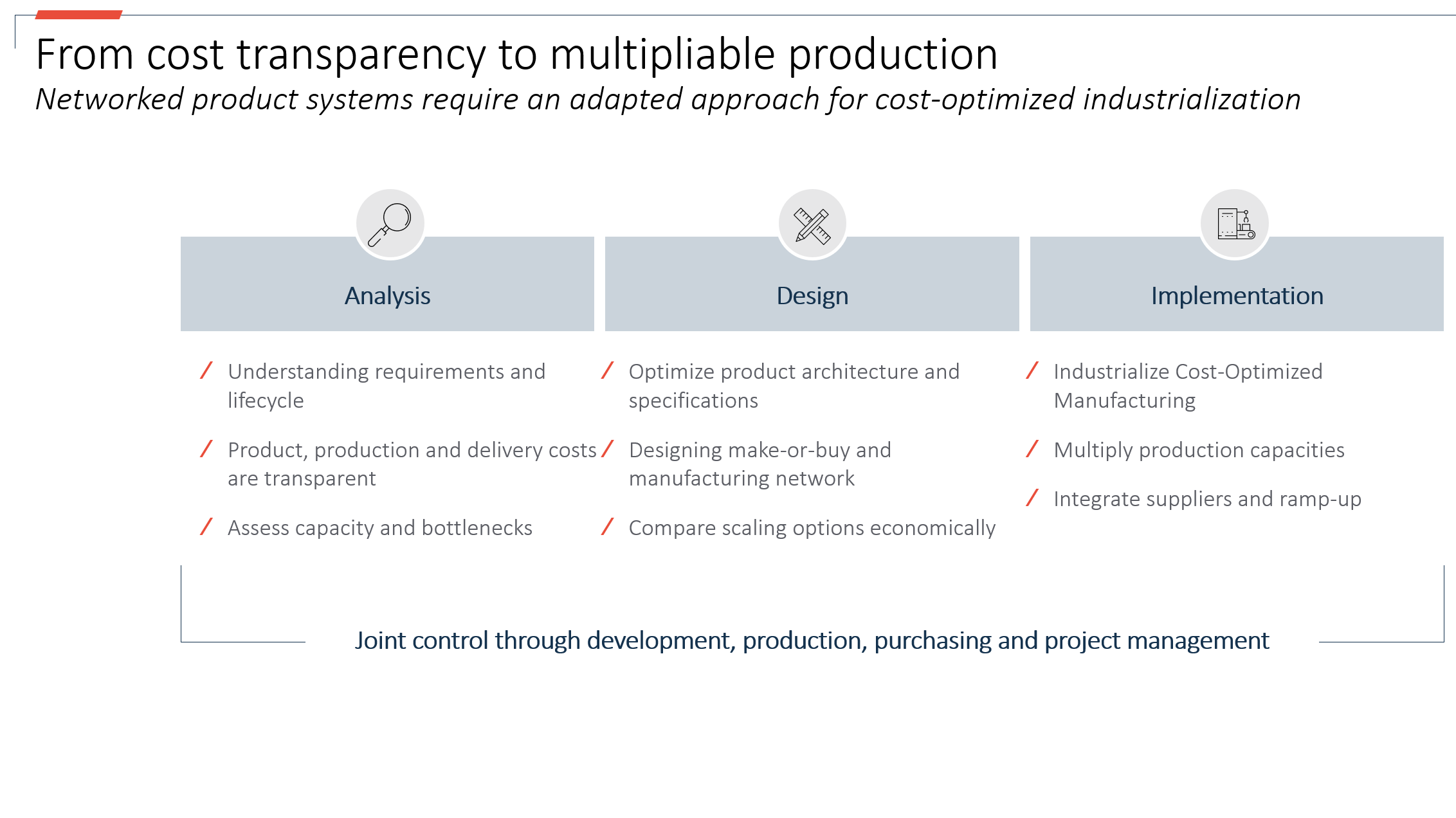
The starting point is an end-to-end analysis of future product requirements, existing cost structures, and industrial capabilities. Should-cost analyses identify where significant costs arise and which alternatives are economically attractive. Building on this, product architecture, manufacturing concepts, and make-or-buy decisions are jointly refined.
The subsequent implementation is crucial: cost optimization and ramp-up must not be carried out separately. Product changes, manufacturing processes, and suppliers must be coordinated in such a way that economic potential can be realized even as production volumes increase.
What opportunities can be tapped in practice?
A project aimed at optimizing the costs of an autonomous land system demonstrates just how effective this approach can be. The goal was to reduce manufacturing costs while simultaneously evaluating options for potential mass production within the European Union.
To this end, the validated bill of materials, selected components, and manufacturing and assembly processes were analyzed in detail. In addition, a comparison of alternative production sites was conducted, taking into account site-specific labor and equipment costs. Potential suppliers and various make-or-buy options were also examined.
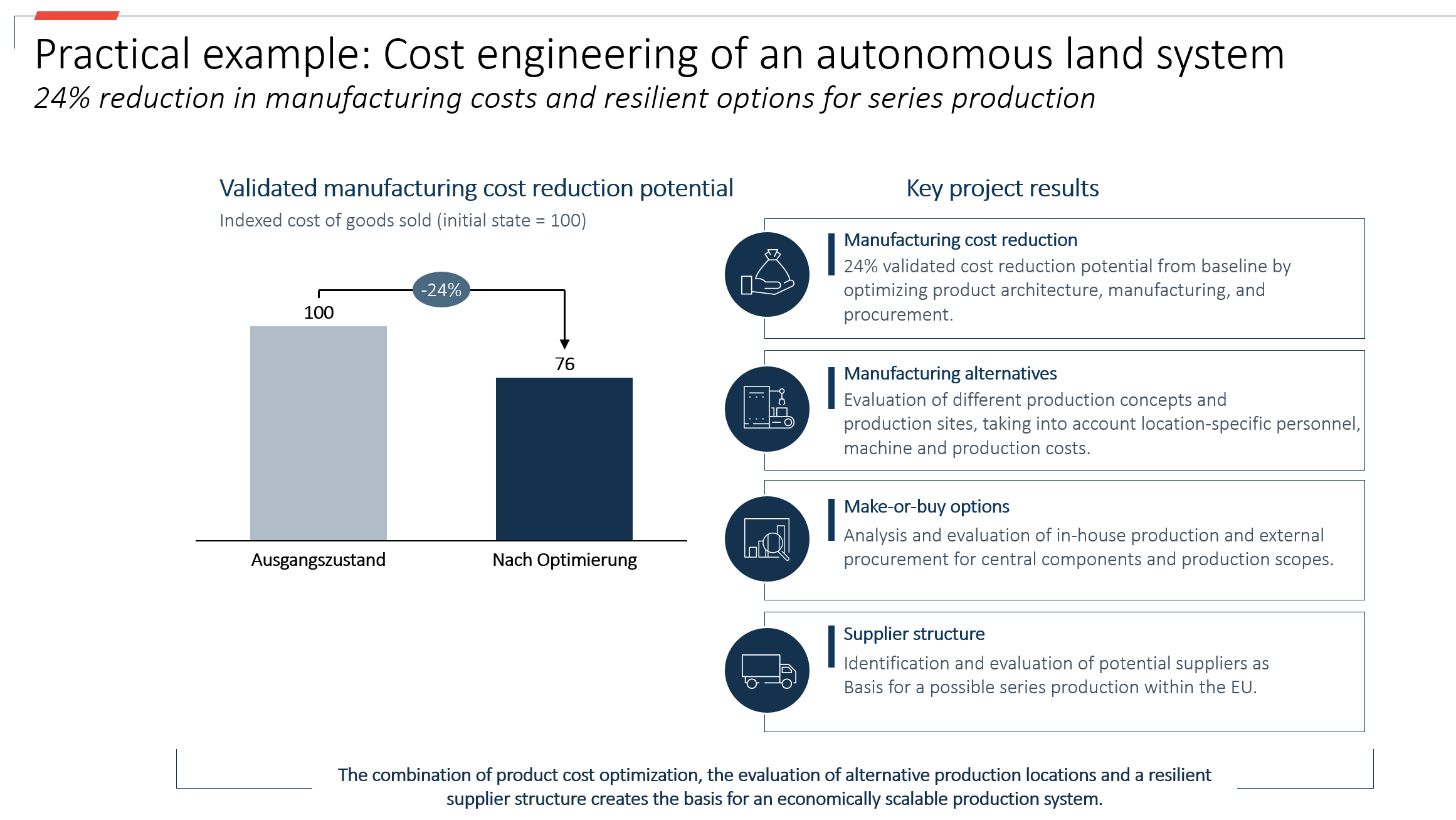
As a result, a potential for reducing manufacturing costs by 24% was validated. At the same time, a solid foundation was established for decisions regarding vertical integration, production locations, and supplier structure.
This example shows that cost optimization does more than just create savings potential. When implemented correctly, it also provides the foundation for an economically scalable production system.
What will determine the next level of competitiveness?
Defense growth will not be successfully managed solely by the companies that build up additional capacity the fastest. What will be decisive is which companies consistently align their product design, manufacturing, and supply network with new requirements and higher production volumes.
For this to happen, three things must come together:
- Product systems whose specifications are based on actual operational requirements.
- Manufacturing processes that can be standardized and replicated at other locations.
- And an industrial network that enables rising production rates at competitive costs.
From our perspective, product cost optimization is therefore not a downstream procurement task, but an essential component of industrial transformation. It links the question of the right product with the question of the most economical way to produce it in large quantities.
The central question is thus no longer simply: “What production rate can our industrial network reliably deliver?”
The central question is:
“How do we need to change our product systems and manufacturing structures so that we can achieve the next production rate cost-effectively?”
This question can be answered systematically. Those who make cost structures, barriers to scaling, and industrial alternatives transparent early on can make the right decisions before building additional capacity.
After all, economic scaling does not result from simply multiplying existing production. It results from designing products and production systems from the outset to be scalable.
Talk to
our experts
Talk to us. Together, we'll lay the groundwork for economically scalable manufacturing.