Financial Asset Navigator: Planning Market Potential for Individual and Corporate Clients

How big is your market potential — and what is realistically achievable?
In practice, this question is often answered only partially: using historical actual figures, general growth assumptions, or product-specific market studies from individual providers. This is often insufficient. After all, financial wealth accumulation is volatile, varies by region, and shifts between asset classes over time.
This is exactly where our Financial Asset Navigator comes in. The dashboard is based on data from the Deutsche Bundesbank’s reporting system and combines this with regional market dynamics and AI-powered forecasts. This creates a provider-independent, well-founded basis for planning, sales management, and strategic decisions. This gives financial institutions a reliable view of market shares, market potential, and future developments — broken down by region, time period, and asset class.
What the Financial Asset Navigator Does
The Financial Asset Navigator supports institutions in four key areas in particular:
- Transparency Regarding Historical Trends
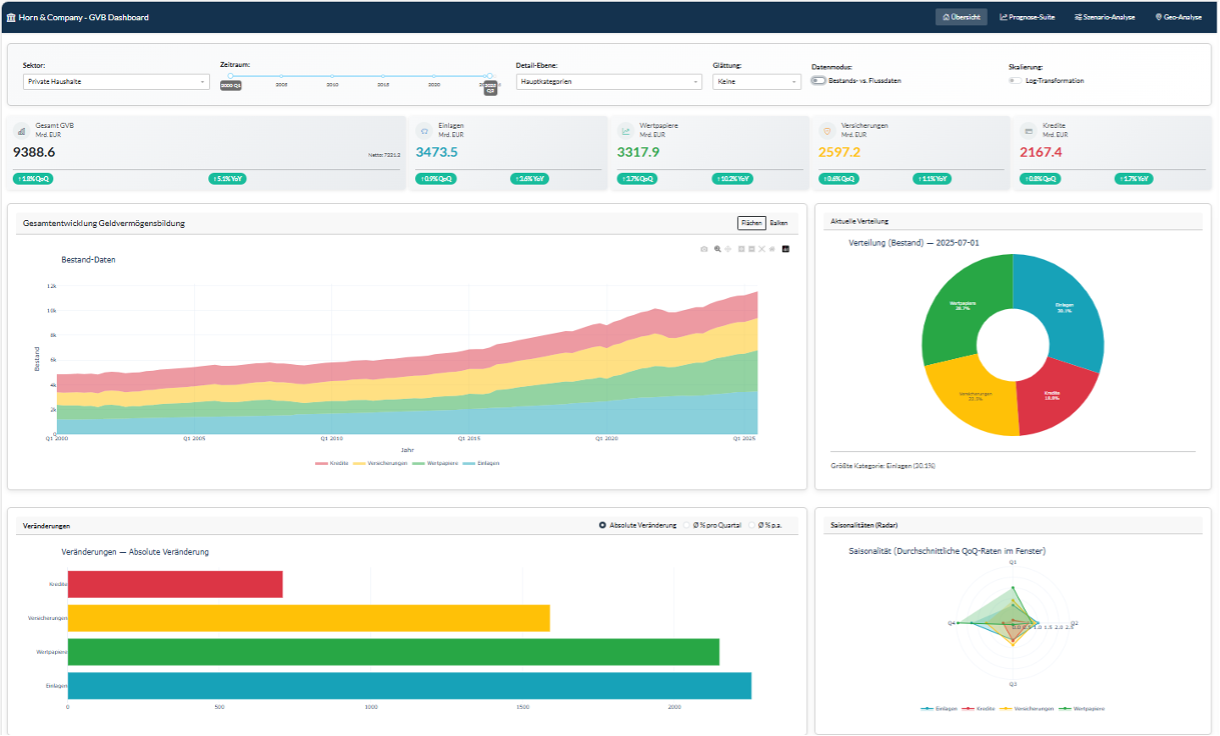
The dashboard provides a fact-based overview of trends in financial asset accumulation and its volatility (see Figure 1). Key asset classes such as deposits, securities, capital-forming insurance policies, and loans can be analyzed separately. - Forecasts of Future Financial Asset Accumulation
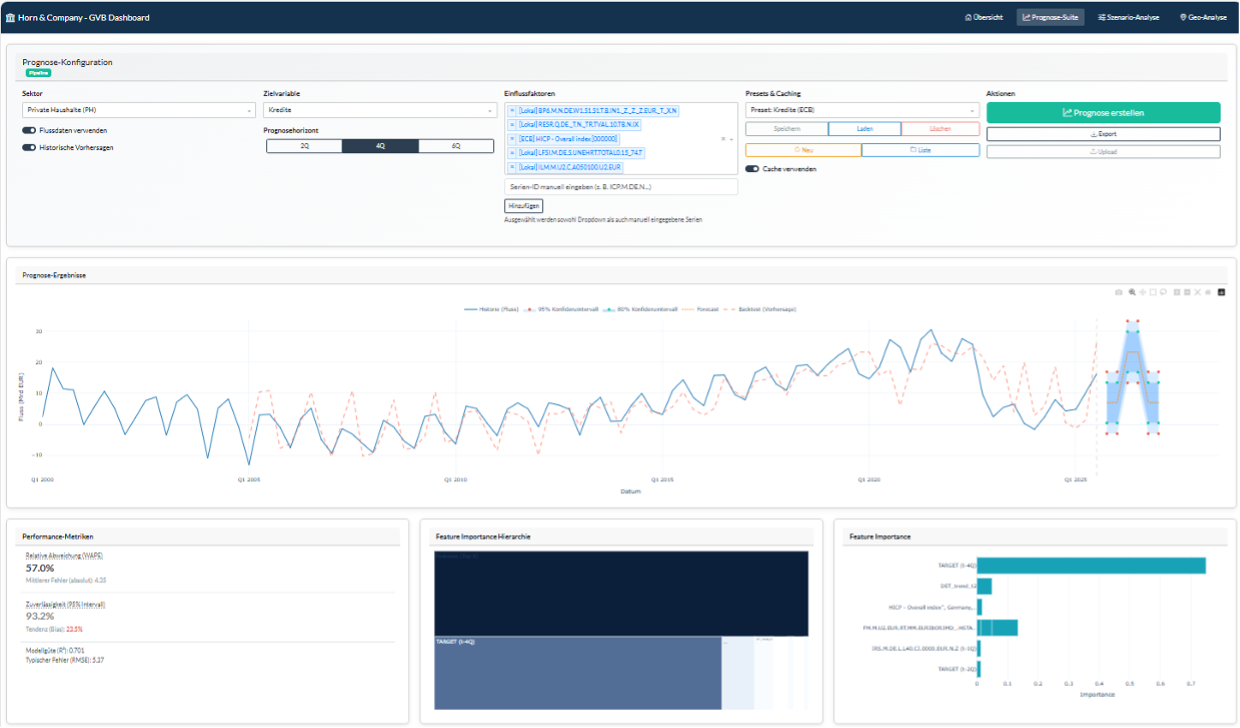
Based on macroeconomic factors, regional structures, and AI-supported analytics, future trends in financial asset accumulation can be forecasted—including for individual asset classes and across different time horizons (see Figure 2). - Regional Breakdown Down to the Business Area
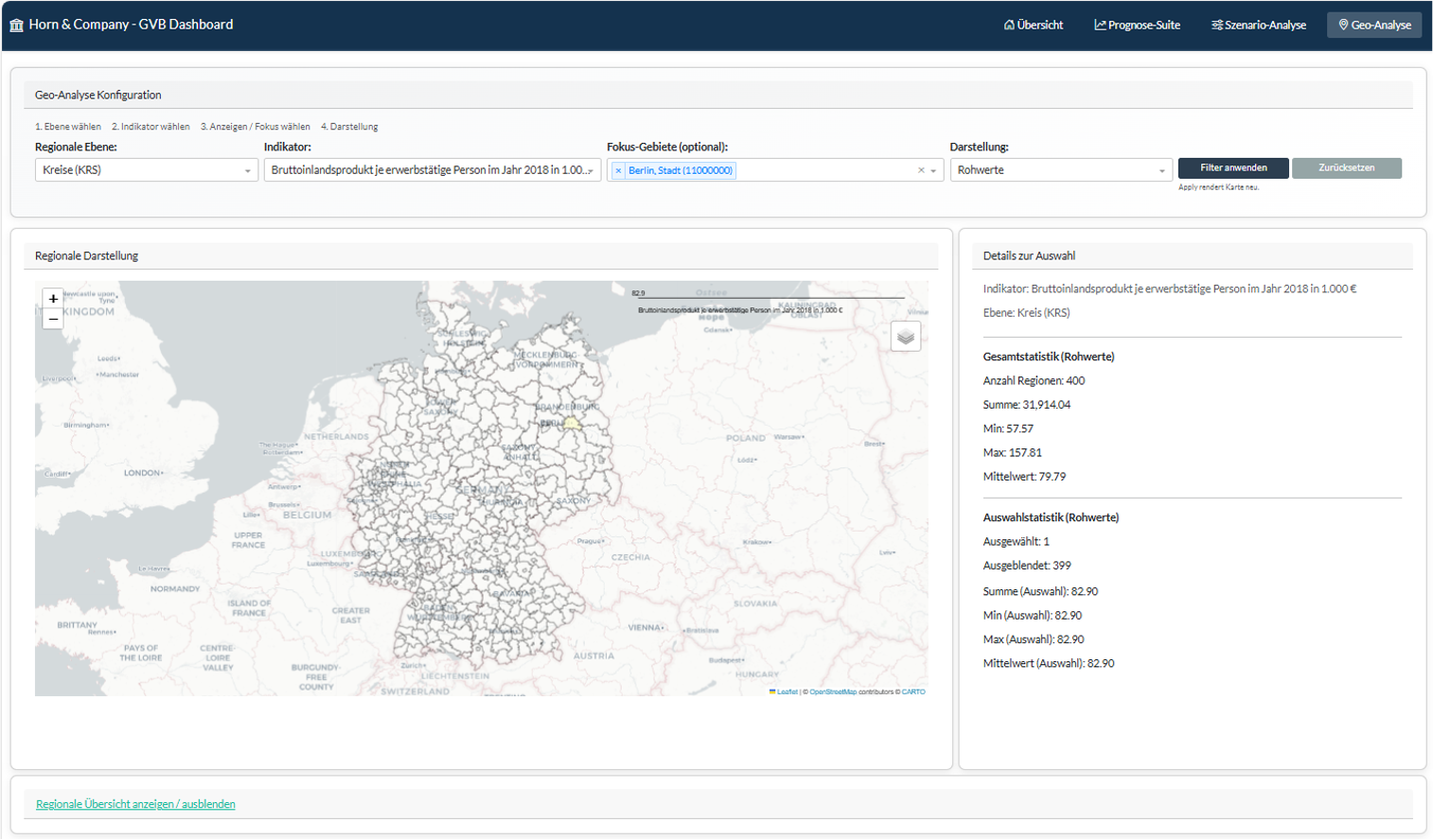
Nationwide trends are methodologically robustly broken down by region (see Figure 3). This reveals regional differences and makes market potential within one’s own business area more tangible. - Derivation of Strategic Planning Metrics
The forecasts can be linked to an institution’s individual market shares. In this way, general market trends can be used to derive concrete, regionally differentiated targets for planning and sales management.
Why this is relevant
Many financial institutions face the same challenge: They must set targets for new business, even though customer behavior does not follow a linear pattern.
Customers do not allocate their money according to the same pattern every year. In some periods, funds flow more heavily into deposits, while in others they tend to go toward securities or insurance products. At the same time, market potential varies significantly from region to region. Those who rely solely on prior-year figures or blanket growth rates run the risk of misjudging potential and causing planning deviations.
The Financial Asset Navigator provides a more reliable basis for this.
Typical Use Cases in Banks and Savings Banks
This application is particularly relevant in three areas:
Transparency Regarding Market Position and Regional Market Shares
The Financial Asset Navigator provides transparency regarding an institution’s current market position across relevant asset classes and highlights regional differences — down to the county level, for example. This creates a reliable picture of the institution’s current situation, serving as a foundation for strategic assessment and fact-based planning.
Validating New Business Targets
The dashboard helps derive realistic targets for new business based on expected market trends rather than solely on historical data. This allows for a more sound validation of top-down targets and better alignment with the business units’ plans.
Targeted Input for Sales Management and Action Planning
Regional and product-specific differentiation provides a solid foundation for targeting sales initiatives, pricing strategies, and budget allocation more effectively. Priorities can be set where the greatest market potential or the most significant deviations from the company’s own position are evident.
Conclusion
The Financial Assets Navigator provides a solid foundation for planning and sales management, enabling financial institutions to better understand market trends, systematically assess regional potential, and derive planning metrics with greater accuracy. Consistent use strengthens acceptance among relevant stakeholders and makes the unique characteristics of a business model and business area more apparent over time. For banks and savings banks looking to further develop their sales and management strategies, this can create tangible added value.
Would you like to learn more or see the dashboard in a demo?
Horn & Company regularly supports banks, savings banks, and other financial service providers with issues related to banking and sales management. Our experts draw on a wealth of experience in this area. We’d be happy to support you as well. Feel free to contact us!