
Replacement vs. Maintenance: Strategies for Optimizing the Asset Lifecycle

Replacement investments vs. Maintenance investments: How to optimize the life cycle of equipment.
When it comes to asset life cycle management, every industrial company is faced with the decision whether to invest in new plants or to upgrade existing plants for profitable continued operation through maintenance investments. Because replacement investments, i.e. new systems, significantly cost more than maintenance investments, a major economic lever lies in optimizing the share of maintenance investments for your own company.
When planning the investment in a new system, the framework conditions should be carefully examined. Is a new acquisition necessary, or are maintenance investments an alternative, with which production can continue in a similarly profitable manner, but investment costs are only a fraction of those for a new system? Horn & Company analyses show that often premature and expensive decisions are made to invest in new equipment. The main reason for this is that companies neglect to collect and evaluate the necessary information to calculate the risk of spare parts availability and equipment failure.
Horn & Company has therefore developed a method for asset life cycle management that enables a comprehensive risk assessment for the procurement of spare parts and the system failure. This allows a risk-based asset status to be determined, which can be used to optimize the share of maintenance investments.
Maintaining systems through revision or retrofit?
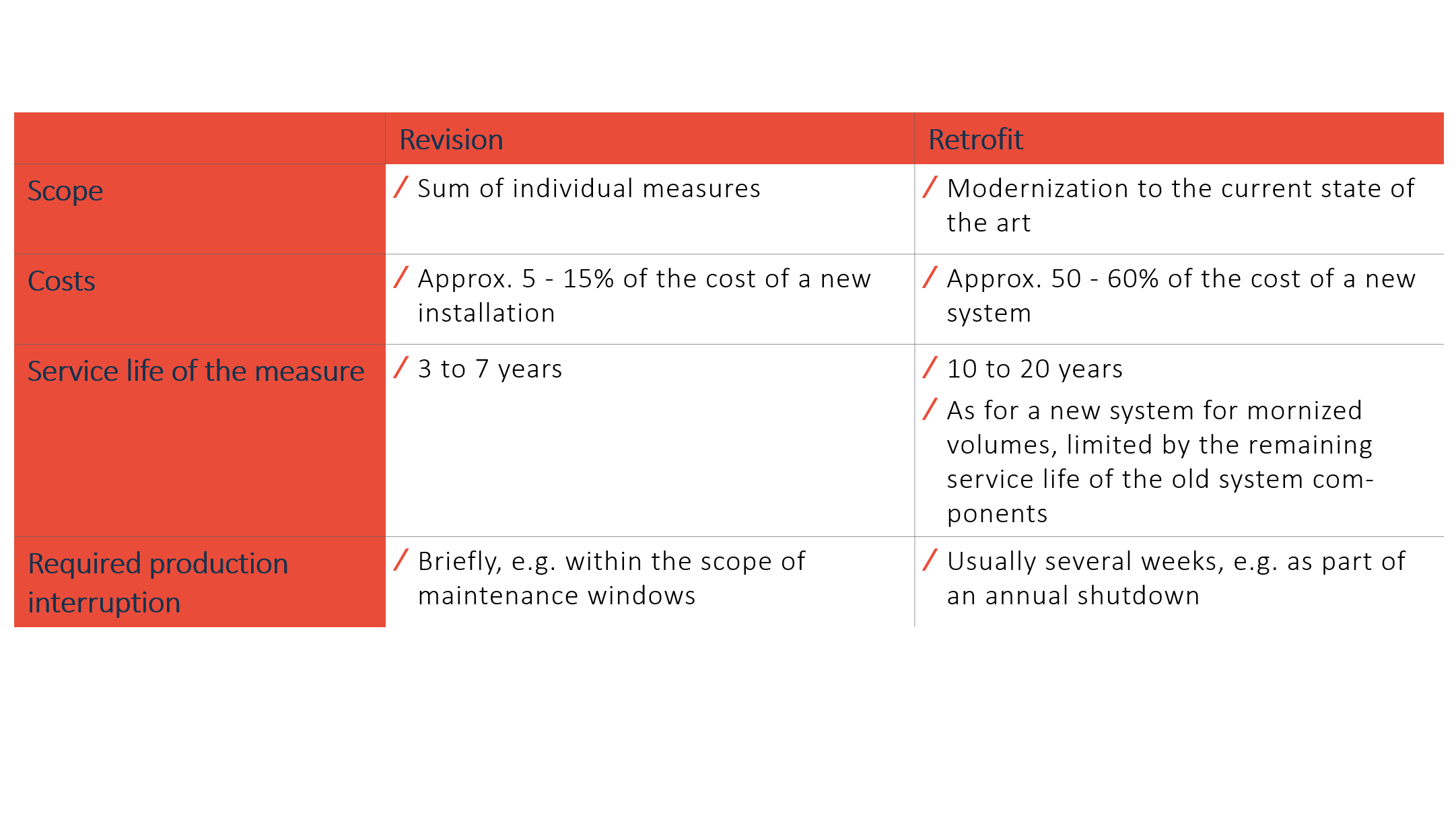
Maintenance investments are comprehensive measures for an installation that go beyond the normal budgeted maintenance scopes for prevention and optimization. Depending on the scope, a distinction is made between revision and retrofit.
- The revision mainly comprises repair measures, for preventive maintenance and smaller optimization measures. The aim is to restore the existing system to the best possible condition by systematically replacing spare parts.
- With a retrofit solution, proven, robust system components are retained, obsolete or worn system components are modernized; complete systems (e.g. control system, control panel, bus and drives of a system) are brought up to the latest state of the art.
Comparison: Revision vs.Retrofit
Savings potential by optimizing the proportion of maintenance investments
When deciding on an individual investment project, the savings potential of an overhaul solution amounts to 85–95% of the investment required for a new asset, while a retrofit project typically accounts for around half of the cost of a new installation. The benefit is realized through the deferral or avoidance of capital expenditures.
To illustrate the economic leverage, empirical project experience was used to compare, for an assumed asset base of EUR 100 million, the internal implementation costs of an investment optimization project with the benefits generated by an optimal allocation of investments between maintenance and replacement.
The project return (benefit relative to implementation costs) is conservatively estimated at greater than 5:1.
Why misjudgements lead to excessive investment costs
Although the business case for maintenance investments is often clearly positive, in practice many investment decisions are nevertheless made in favor of a new system. The following factors are responsible for this misjudgment:
- Uncertainty in risk assessment
In many companies, there is no established method and rules for assessing the operational risk of the legacy system. - Uncertainty regarding the current supply situation for spare parts
In particular for electrical/electronic components the life cycles are much shorter than the planned service life for the system. - Lack of supplier partnerships to ensure the long-term continued operation of the old system
- The commissioning risk for the new system is underestimated
New systems are more complex in terms of control systems. Until a new system can be operated with the same productivity as the old system, it often takes considerably longer than promised by the manufacturer. - Underestimated skills required to operate the new system
Every new system requires both the system operator and the maintenance staff, to learn how to use the new technology.
Asset Life Cycle Management from Horn & Company:
Systematically assess spare parts risks and failure risks.
If system and operating data is available in sufficient quality, Horn & Company Asset Life Cycle Management can be carried out quickly. The method introduces a risk-based system traffic light that enables rapid risk assessment. Practice shows that many companies have insufficient spare parts data. This problem can be solved by using AI-based methods to optimize in-house data and by working with external service providers to consolidate spare parts data.
Success factors for maintenance investments
Effective Risk Management
Effective risk management ensures, that the legacy system is operated below a threshold risk defined by the company and that countermeasures are initiated in good time if the risk situation changes.
The first step is to determine the limit. First, the maximum tolerated consequence of failure for the company must be defined. The consequence results from the losses in contribution margins in the event of a prolonged system failure. As a rule, there are several threshold values that lead to different strong reactions from customers. The customer reactions are evaluated in monetary terms.
The second factor is the probability of component failure of maintenance and production. The risk assessment results from the combination of probability and consequence. As long as the risk assessment is within the tolerated range, the old plant is operated safely.
Development of Supplier Partnerships and Spare Parts Strategies
Supplier partnerships and spare parts strategies ensure the stable and productive continued operation of older systems. The main focus is on maintaining a sufficient stock of spare parts, repairing spare parts for systems, including control elements, for example, or even replicating spare parts. In addition, the conversion of systems with corresponding downstream components and modernization through a retrofit can also ensure profitable continued operations.
Our figure illustrates the key building blocks of a strategy that combines the development of supplier partnerships with access to spare parts.
Conclusion
Check the risk-protected continued operation of existing systems now and save high investment costs.
Analyze the current risk for your asset pool. In addition to safeguarding your productions ability, especially with older systems, you can tap into the ability to postpone or even avoid investments. Horn & Company offers you the know-how you need to prepare your production for the future at optimum cost.
Efficient Asset Life Cycle Management requires the interaction of many specialists in the evaluation of existing assets, IT know-how and the ability to build up a "community" of partner companies for life-extending measures.
Ready to take the next step?
Whether you’re just starting to think about it or have concrete plans — we’ll listen, ask questions, and work with you to develop your ideas further. In a no-obligation initial consultation, we’ll assess where you stand and how we can support you.