Brace, Brace, Emergency Position – The Fashion Retail Industry in a Tailspin

What risks are now emerging for private equity firms and banks
For private equity investors, current trends mean that many of the equity stories they had built their cases on are no longer viable. Revenue growth is stalling, margins are under pressure, exit windows are closing, covenants are being breached, and an exit bottleneck is emerging. Buy-and-build strategies are hitting operational limits when cash conversion no longer works and working capital becomes a risk. As a result, the focus of many investments is shifting from growth and multiples to liquidity, operational stabilization, and resilient value preservation.
On the banking side, reality is also shifting noticeably. Banks’ intensive care and workout departments are increasingly seeing cases from the retail and consumer goods industries where the cause is no longer just short-term liquidity bottlenecks, but structural market changes. The number of companies requiring increased support is rising, and with it the realization that many business models were built on growth assumptions that are unattainable under current market conditions. For financiers, it is therefore crucial to distinguish early on between temporary dips in earnings and structurally vulnerable business models.
The Current State of the German Fashion Retail Industry
GFK Consumer Confidence Index (Statista 2026)
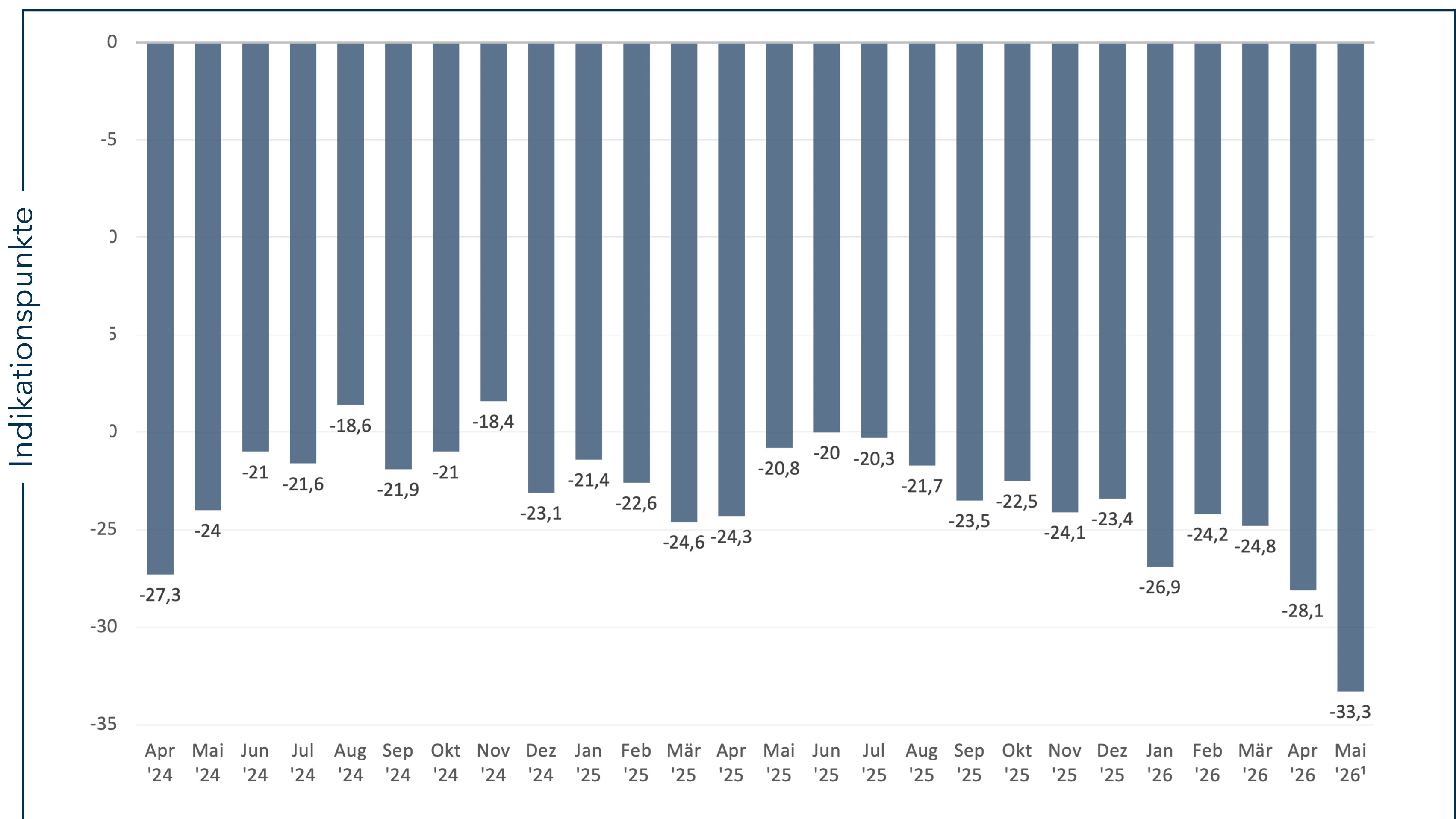
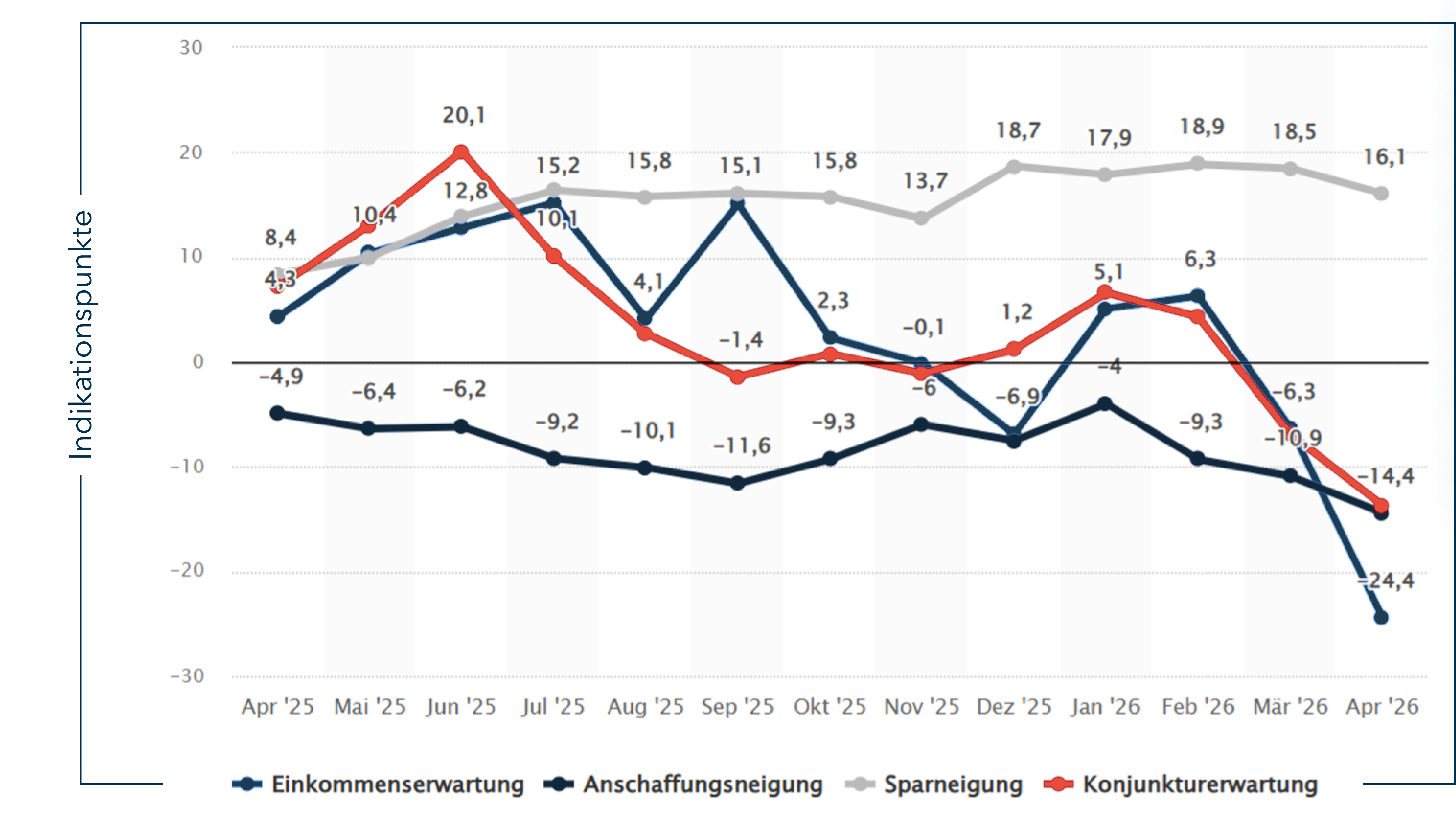
The current consumer sentiment sends a clear signal. The GfK Consumer Climate Index fell to 33.3 points in May 2026 — the lowest level since February 2023. Income expectations and the propensity to spend have hit a two-year low, while the propensity to save remains at a historically high level.
GfK Consumer Climate Index: Survey in Germany on economic expectations, income expectations, and propensity to buy from April 2025 to April 2026 (Statista, 2026)
In other words:
- Consumers are postponing purchases
- Customers are shopping more selectively
- Foot traffic remains under pressure
- Price and promotional campaigns are losing their effectiveness
- Inventory levels are rising due to lack of sales
The fundamental misconception
Many companies are still operating based on the mindset of the pre-crisis years. Their hopes sound familiar:
Hope is not a strategy!
“Business will pick up again.”
“Next season will be better.”
“If the weather cooperates, the market will turn around.”
The Critical Management Task
Securing liquidity, reducing inventory, and increasing speed — that is the core task. Those who fail to act decisively today will be overwhelmed by their own inventory tomorrow.
The fashion market is not only suffering from weak demand. Above all, it is suffering from structural inertia:
- Excessive inventory levels
- Processes and response times that are too slow
- Insufficient transparency in key performance indicators
- Too little operational control along the value chain
- Now more than ever, there is a need for more intensive and structured dialogue between manufacturers and retailers. Collaborative planning is no longer an option — it is a matter of survival.
The New Order Logic in Retail
The era of traditional volume maximization is over. Shorter cycles, smaller volumes, rapid response—that is the new management model:
- Smaller, more flexible purchase volumes
- Shorter control cycles
- Consistent focus on sales
- Robust and honest scenario planning
- Daily transparency regarding sales, inventory, gross profit, and liquidity
Restructuring does not begin in the event of insolvency. It begins the moment companies realize that the market has changed permanently. And that is exactly what we are experiencing right now.
WHICH COMPANIES WILL SUCCEED IN THE COMING YEARS
The winners won’t be the loudest brands, the largest retail chains, or the most aggressive discounters. The winners will be companies that:
- have a firm grasp of their numbers
- adopt a lean structure
- consistently operate in a metrics-driven manner
- actively manage inventory
- make decisions faster than the competition
- have the courage to question old models of success
Because one thing is clear: waiting it out is not an option.
Brace. Brace. Emergency Position.
The time to act is NOW!
Ready to take the next step?
Whether you have initial ideas or concrete plans, we listen, ask questions, and develop them further together. In a non-binding initial consultation, we clarify where you stand and how we can support you.