From database to generative AI: A robust development path for retailers

Artificial intelligence is ubiquitous in commerce. Hardly any strategic discussion can do without reference to generative models, autonomous systems, or data-driven decision support. The promises are great: increased efficiency, new business models, personalized customer experiences, automated processes.
At the same time, the reality is quite different. Many AI initiatives fall short of expectations. Individual projects are implemented in isolation, technologies are introduced without being sustainably integrated into processes and decision-making logic, and the foundations necessary for success are not laid. Initially, there is great enthusiasm and investments are made—but eventually disillusionment sets in when no effective P&L effects materialize.
So the key question is not whether AI is relevant in retail. Rather, it is: How can AI be used in a way that creates structured value—both today and in the future?
Between hype and value contribution
Technological possibilities alone do not generate economic added value. The decisive factor is whether they are embedded in a goal-oriented transformation logic. This is precisely where tensions often arise in retail:
- On the one hand, there is short-term pressure to create visible added value through innovation.
- On the other hand, there are mature system landscapes, fragmented data sets, and historically developed processes.
With the right approach, the transition to a data-driven company is not a risky investment case, but a predictable process that generates significant P&L effects along the way.
Why isolated applications rarely scale
Many AI initiatives begin with a clearly defined use case: sales forecasting here, a chatbot there, price optimization in a product group. Such approaches are understandable. They promise quick results and manageable risks.
However, they often lack integration into an overarching development path. There are three typical structural reasons for this:
Firstly: The database is not (sufficiently) consistent.
AI models reinforce what is stored in the data. If master data is incomplete, interfaces are inconsistent, or external data sources are not integrated, models will be created—but no reliable decisions will be made.
Secondly, business impact is not measured systematically.
Without clear targets for revenue, costs, inventories, or working capital, the contribution to value creation remains vague.
Thirdly, technological maturity and organizational maturity do not develop synchronously.
A forecasting model may work technically, but if decision-making processes, roles, and responsibilities are not adapted, its influence will remain limited.
The consequence is not to use less AI, but to use it in a more structured way.
AI along the central value creation fields
Use case journeys are not an abstract model. They gradually unfold their effect along the core functions of a retail company:
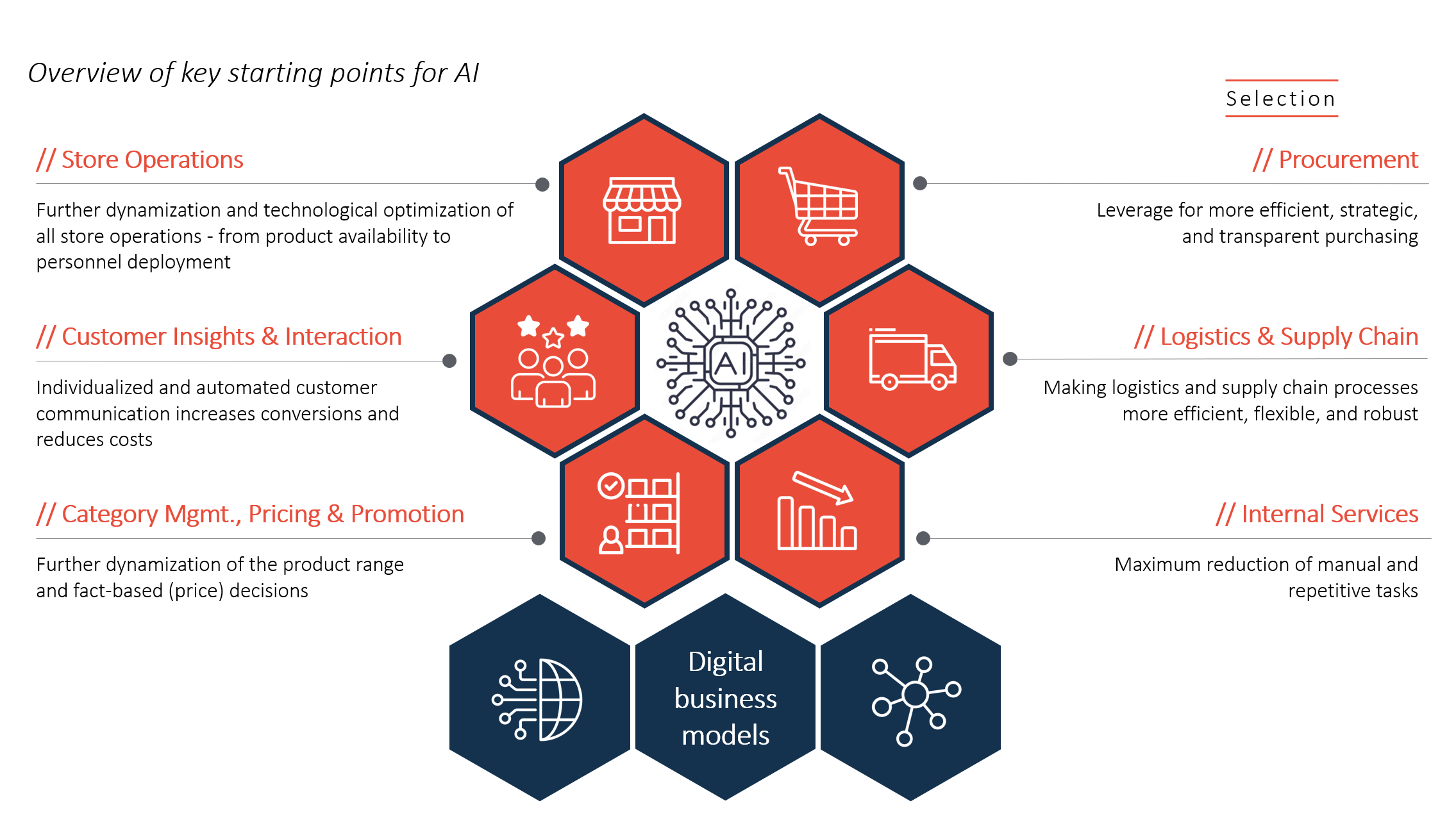
Use cases can be identified in each of these fields that can be developed along the maturity level described. Prioritization is also crucial:
Not every use case is appropriate at every point in time. Criteria such as business benefits, technological feasibility, organizational connectivity, and competitive activities determine the order.
The logic of use case journeys
A resilient development path for AI in retail does not begin with generative applications. As mentioned above, it begins with a clear data and process basis.
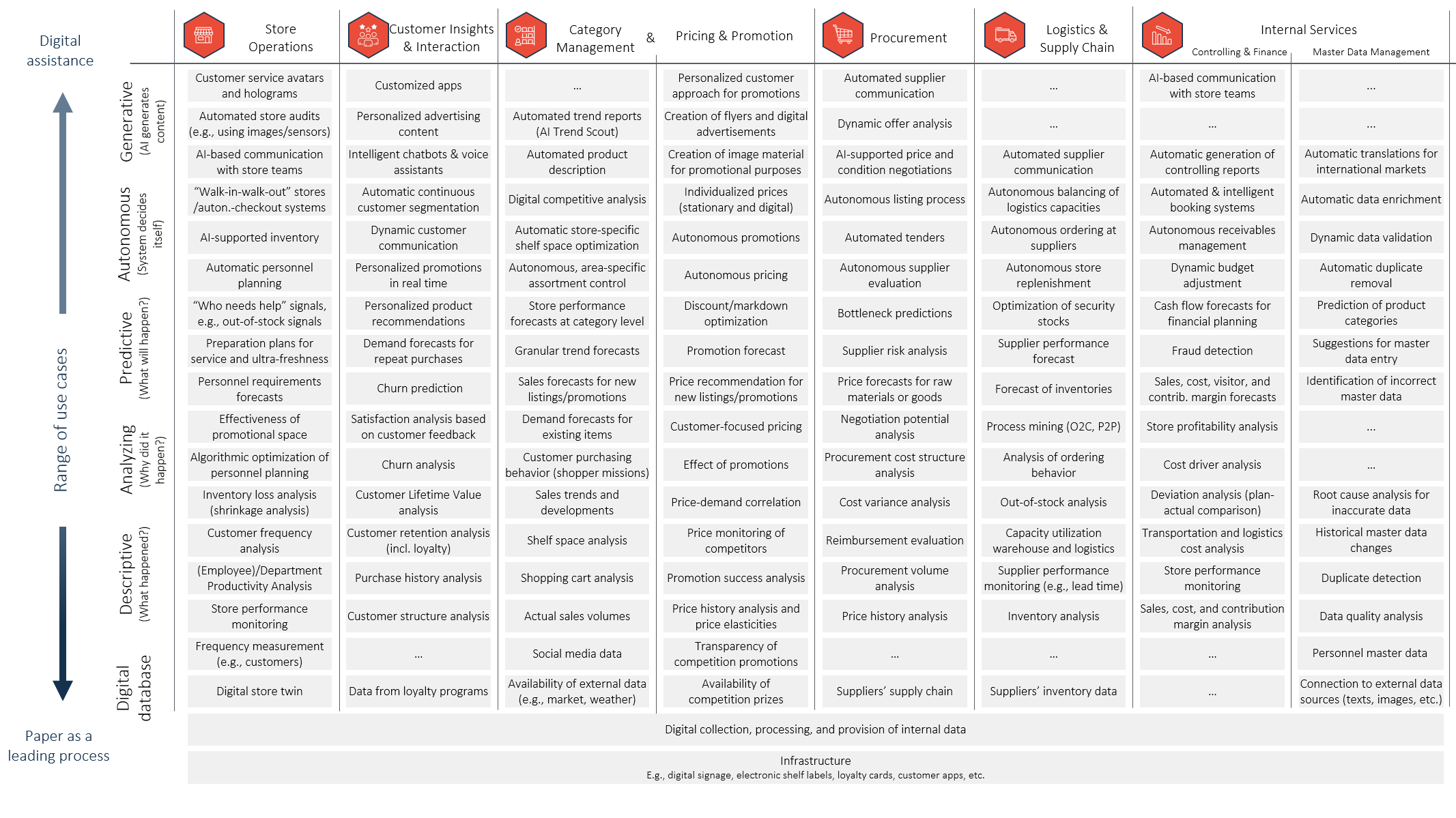
Instead of isolated flagship projects, what is needed is a use case journey—a systematic development along successive stages of maturity. This can be simplified into a five-level structure:
- Digital Database
Reliable, consistent, and integrated data as a foundation. Without clean master data, clear data models, and defined governance, any further application remains fragile. - Descriptive Transparency
What happened? Standardized KPI systems, consistent reports, and transparent performance measurement create the basis for fact-based decisions. - Analytical Insight
Why did something happen? Pattern recognition, root cause analysis, and process mining enable a deeper understanding of deviations and potential. - Predictive Models
What will happen? Forecasts for sales, demand, staffing requirements, or delivery performance increase planning reliability and reduce uncertainty. - Autonomous and Generative Applications
Systems make decisions or generate content independently. However, this level only takes effect if the previous levels are firmly established.
It is essential to note that each stage builds on the previous one. Anyone who implements generative AI without having established transparency and predictive capabilities is skipping necessary development steps. An increase along the maturity axis symbolizes not only technological complexity, but also growing influence on the P&L, albeit with increasing organizational requirements.
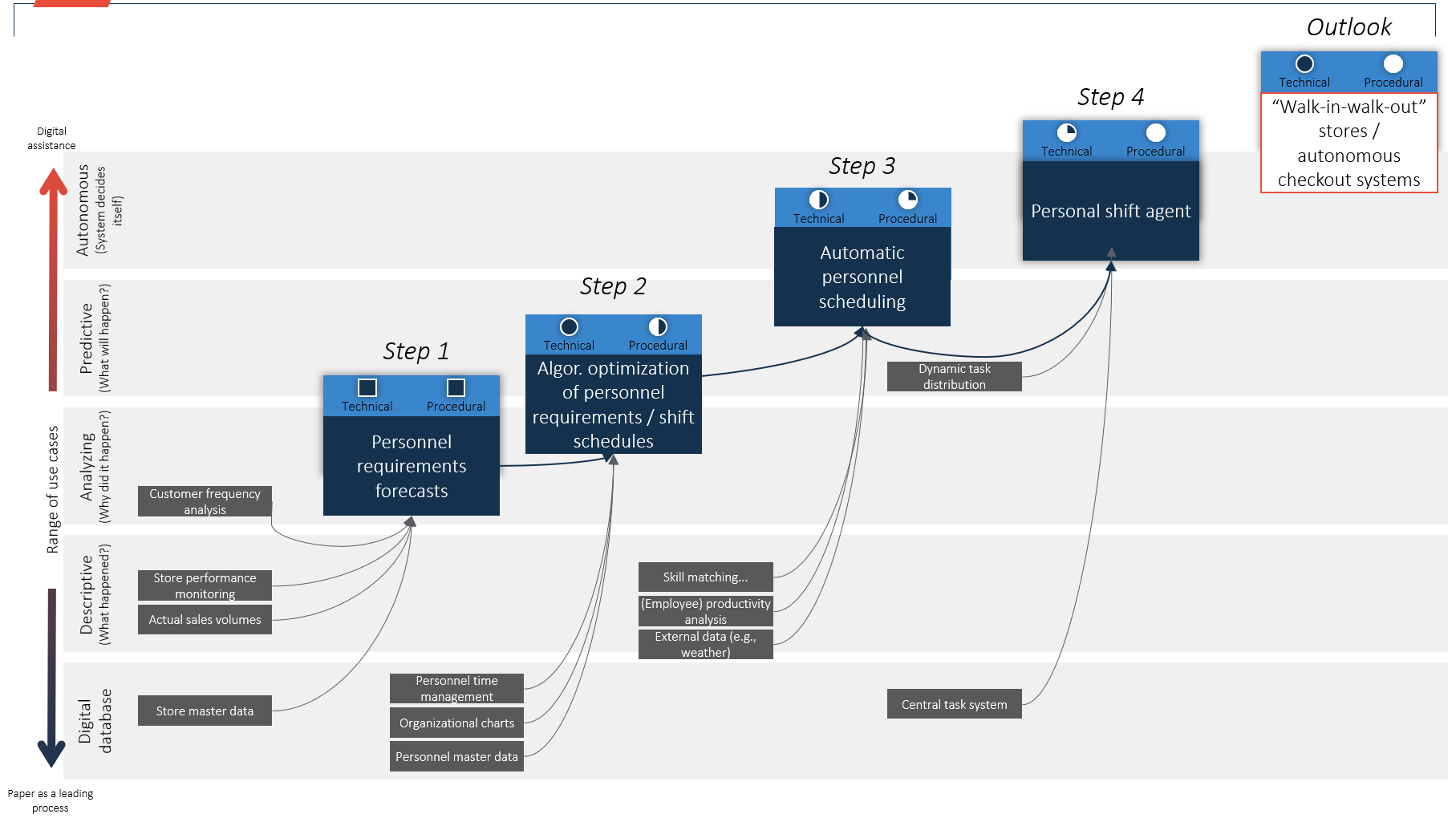
Illustrative Use Case Journey: Effective Staffing at the Point of Sale (PoS)
A concrete example from the area of store operations illustrates this logic.
The journey begins with a clean data foundation:
sales figures, customer frequencies, employee master data, time-tracking data, and external factors such as weather or regional events are consistently integrated.
At the descriptive level, transparency is created around productivity, department performance, and peak times.
The analytical stage identifies patterns:
which factors lead to overstaffing or understaffing? Where do waiting times or revenue losses occur?
Building on this, predictive models enable forward-looking workforce planning. Shift schedules are no longer created purely based on historical data but are optimized using data-driven insights.
Only on this foundation can further automation take place:
algorithms independently suggest staffing plans or adjust them dynamically.
At a more advanced stage, autonomous systems can distribute operational tasks or support staff in real time.
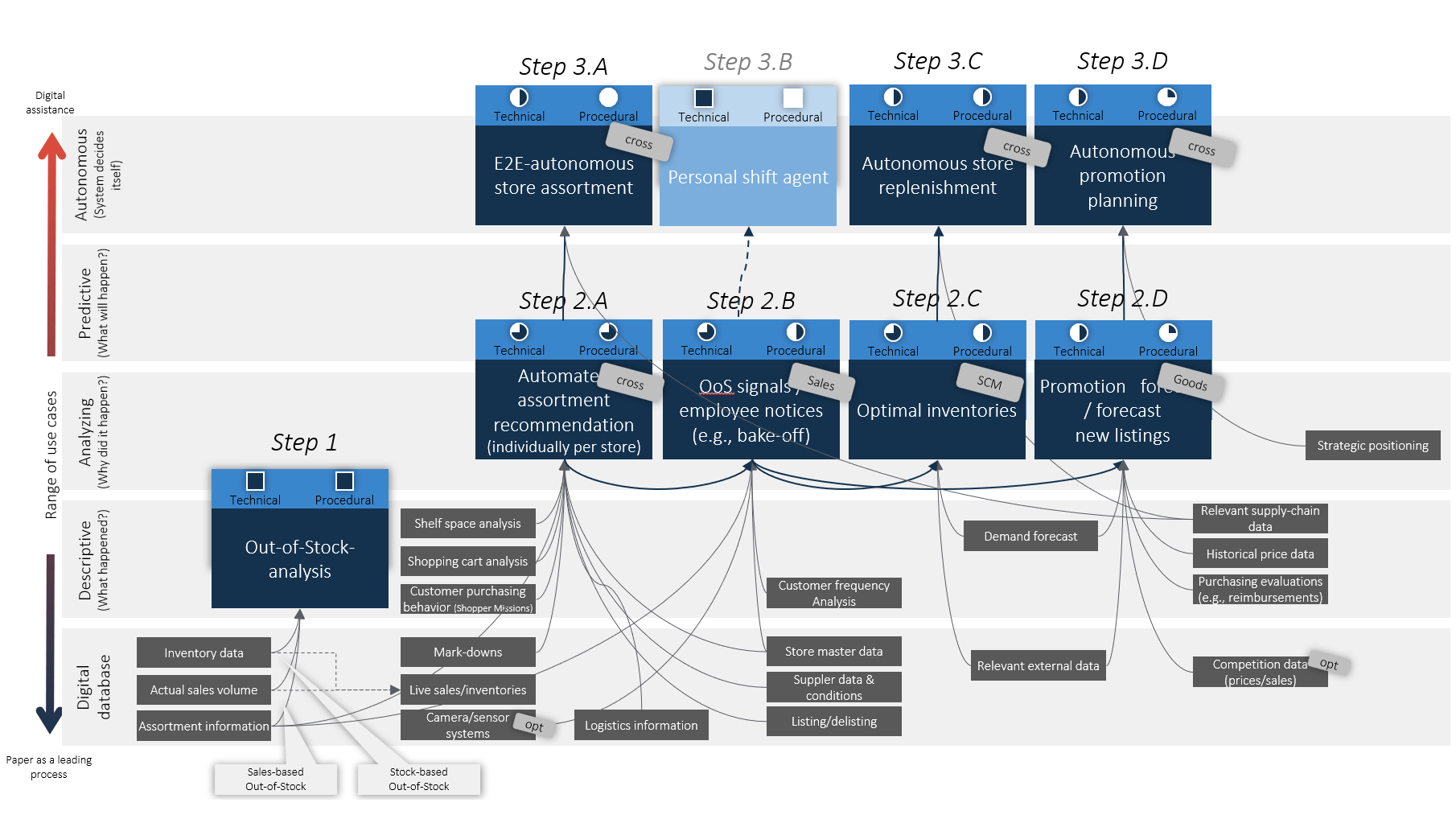
Example Use Case Journey: Product Supply
Another example can be found in inventory replenishment.
Here, too, the development begins with the integration of key data:
Sales figures, inventory levels, supplier information, assortment data, and external market or competitive information.
The descriptive level creates transparency around out-of-stock rates, inventory coverage, and write-offs.
Analytical models identify root causes:
Are stockouts caused by forecasting errors, supplier performance issues, or process deviations?
The predictive stage enables more precise demand forecasts, differentiated by store, category, or promotion.
Only on this basis can further automation take place:
Autonomous replenishment decisions, algorithm-driven promotion planning, or dynamic adjustments aligned with strategic targets.
Conclusion: AI as a Principle, Not a Project
Effectively leveraging AI in retail requires defining development paths, setting clear priorities, and consistently establishing the necessary organizational prerequisites.
Those who start with a robust data foundation, establish transparency, and gradually integrate predictive models create the basis for autonomous and generative applications with real P&L impact.
In this way, AI becomes not an isolated innovation project, but an integral part of a data-driven operating model.
Ready to define your AI
development path in a
structured way?
We would be happy to discuss where your company stands today, which use cases should be prioritized, and what a robust development path with measurable business impact could look like.