Streamline Instead of Migrate: What Process Mining Reveals During an ERP Upgrade

In just over 13 months, on January 11, 2028, support for Dynamics NAV 2018 — the latest version of NAV — will end. At SAP, mainstream maintenance for ECC will expire as early as the end of 2027. If you don’t start now, you’ll be migrating under time pressure. And if you migrate under time pressure, you’ll carry your legacy issues with you — straight into the AI era.
The end of the year is the perfect time for a thorough cleanup. Budgets and priorities for 2027 are being set now. Those who set up the upgrade properly now will start January with a clear plan instead of a last-minute scramble.
That’s because these deadlines coincide with a second trend: Microsoft and SAP are integrating AI agents directly into ERP systems. These agents are designed to create orders, verify invoices, and handle routine tasks. But an agent can only automate what it finds. An ERP system cluttered with ad-hoc solutions built up over time will slow down any AI before it even gets started.
The upgrade therefore determines more than just the technology. It determines whether a company will benefit from AI in the coming years — or continue to pay off its process debt. Failed ERP migrations show just how much is at stake: well-known corporations are said to have incurred losses of up to half a billion euros.
Our experience shows that these projects rarely fail because of the technology. They fail because no one takes responsibility for the end-to-end process — and because custom solutions are carried over one-to-one into the new system. On the other hand, companies that use the upgrade as an opportunity to streamline their systems end up with a leaner system, faster updates, and a solid foundation for AI. We’ll show how this can be achieved in a data-driven way using Microsoft Business Central as an example.
Business Central Enforces a Clean Break
With Business Central (BC), Microsoft’s ERP system is adopting a new programming model. Under NAV, customizations were programmed directly into the core; BC requires modular extensions. The new model is not backward-compatible: Every customization must be rebuilt — or it will be lost. That is precisely where the opportunity lies. The encapsulated logic makes future updates significantly faster. And the need to rebuild from scratch is the best opportunity in years to get rid of legacy code.
Business leads, not IT
Before the upgrade, an honest assessment is needed: What does the new standard cover? What is no longer needed? And what really needs to be included in the new programming model? Customizations ported on a one-to-one basis may work technically but can still result in a worse system from a business perspective. The key factor is the impact on the process. IT alone cannot assess this — which is why the business unit must lead the project and set the requirements.
A clear strategy applies to customizations:
- Standard where possible. This saves porting costs, leverages proven processes, and makes every future update more cost-effective.
- Customization where it makes sense. Automations that go beyond the standard often yield significant efficiency gains. Rare, complex special cases require a cost-benefit analysis.
- No convenience features. Anything that doesn’t offer a measurable benefit won’t be built from scratch.
We have found that a decision-making committee works well for us: Every customization is presented to senior executives and approved by them. The mere prospect of having to defend one’s own special request before them noticeably increases people’s willingness to cooperate.
Three Paths to the Vision
There are three approaches to assessing the current process (Figure 1):
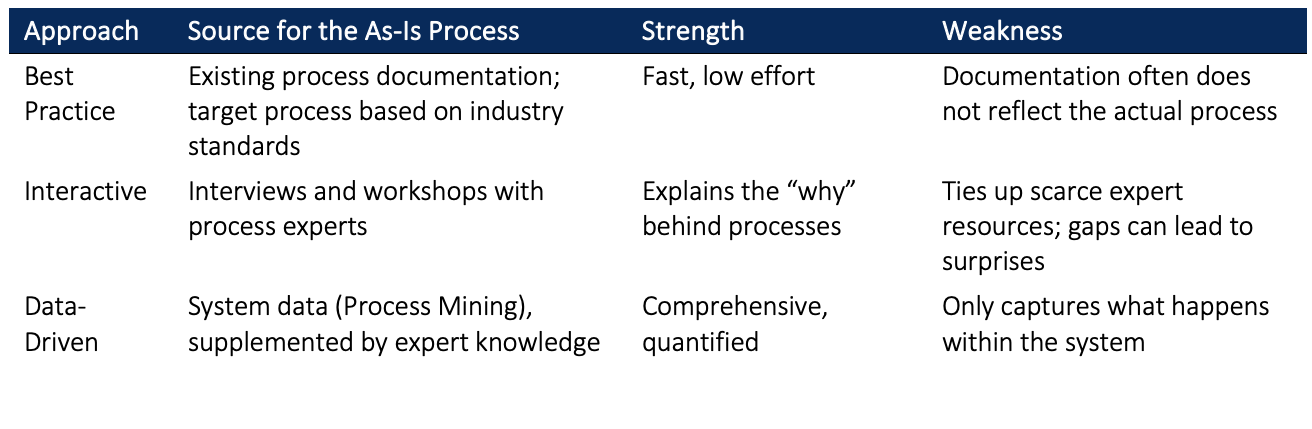
Experts explain why something happens. The data fully reveals what happens. Only this combination yields a reliable picture of the target — which is why we rely on a data-driven approach.
Three Steps to Your Target Vision
1. Make actual processes visible. Process mining reconstructs the actual end-to-end process from ERP data—in full and with volume metrics. Three fields are all that’s needed: activity, timestamp, and transaction ID. This reveals which in-house developments are being used, which interfaces are involved, and where special cases deviate from standard business operations. [Optional: Customer example, e.g., “For one customer, X% of the customizations were no longer used last year.”] Important: Work with subject matter experts to translate the technical data into steps that are understandable to business users. The experts fill in the gaps regarding what happens in Excel or via email.
2. Identify weaknesses using key metrics. The analysis begins with the most common process variant and gradually adds others. Key metrics include the lead time per subprocess (Figure 2), the no-human-touch rate (percentage of transactions without human intervention), and the first-time-right ratio (how often completed tasks are reopened). The most illustrative result is a process heat map: green where the process is close to the ERP standard, red where it deviates significantly. It shows at a glance where the greatest effort will be required during the upgrade.
[Figure 2: Lead Times at the Subprocess Level]
3. Define the target state. The business unit describes which measures address which weaknesses. Decisions on customizations are made in a clear sequence: convenience features and rare special cases are covered by the standard. Productivity levers in high-volume business are evaluated based on key performance indicators. The remaining items are prioritized according to potential, effort, and ROI.
No AI Without Clean Processes
Many companies hope to automate processes at the push of a button using Copilot and AI agents. However, handing over a complex, poorly understood process to AI will, at best, just make it go wrong faster. Process mining analysis provides exactly what AI automation needs:
- The right candidates: high-volume processes with a low “no-human-touch” rate and clear rules.
- A clean foundation: standardized processes instead of ad-hoc workarounds that have evolved over time.
- A benchmark: metrics before and after implementation that demonstrate the benefits.
After go-live, the analysis becomes a control dashboard: Automated data extracts show whether the target state is working, whether old habits are creeping back in, and which processes should be handed over to AI agents next. This transforms a one-time upgrade into continuous process management.
Five Questions You Should Ask Your Project Team Right Now
- Who is responsible for our end-to-end processes — and who decides on customizations?
- Do we know which in-house developments were actually used last year?
- What is the “no-human-touch” rate in our mass processes?
- Which processes do we want to hand over to AI agents in two years — and are they structured well enough for that?
- Is our timeline sufficient to last until the end of support — with a buffer?
Conclusion: It's time to start decluttering
The deadlines are set, and AI agents are just around the corner. Only one question remains: Will you migrate your legacy systems — or will you clean house? Those who simply migrate will pay for their process debt with interest — at the latest when the first AI agents fail because of them. Those who clean house reduce project risk, speed up every future update, and will have an ERP system ready for AI by 2028.
Our suggestion: Use the weeks around the New Year to take an initial look at your process data. Ask your team the five questions above. If you can’t answer at least three of them with numbers, you’ll know where to start.
Clean up instead of migrating — the best time to do it is now.
Housekeeping with Horn & Company: Where Does Your Migration Project Stand?
Whether you have just a few initial ideas or concrete plans — we’ll listen, ask questions, and work with you to develop them further. During a no-obligation initial consultation, we’ll assess where you stand and determine how we can support you.